What Is Rate of Gain in Livestock? Why Should I Track It?
Rate of gain, also known as average daily gain (ADG), is important for farmers raising animals for meat production. It measures how quickly an animal gains weight, usually expressing this in pounds or kilograms per day.
Why Rate of Gain Matters
Tracking average daily gain (ADG) is essential for:
- Maximizing profitability: Faster-growing animals reach market weight sooner, reducing feed and labor costs.
- Measuring feed efficiency: High rate of gain indicates your feeding program is effective.
- Improve Genetics: Breeders often prefer animals with strong rate-of-gain performance for breeding stock.
- Monitoring animal health: Poor weight gain can signal health issues, parasites, or feed problems.
Whether you're raising cattle, pigs, sheep, goats, or poultry, knowing each animal's rate of gain helps you make informed decisions.
How to Calculate Rate of Gain
The formula for rate of gain is simple:
(Ending Weight – Starting Weight) ÷ Number of Days = Average Daily Gain (ADG)
Example:
- Starting Weight: 500 lbs
- Ending Weight: 750 lbs
- Time Period: 60 days
(750 – 500) ÷ 60 = 4.16 lbs/day
This animal gained an average of 4.16 pounds per day during the period.
How Often Should You Weigh Livestock?
The answer depends on your species and goals, but here are general guidelines:
- Cattle & Pigs: Every 30–60 days
- Sheep & Goats: Monthly or every 6–8 weeks
- Poultry: Weekly for meat birds
Consistent weighing helps you monitor progress, adjust feed programs, and detect problems early.
How to Track Weight History and Rate of Gain with FarmKeep
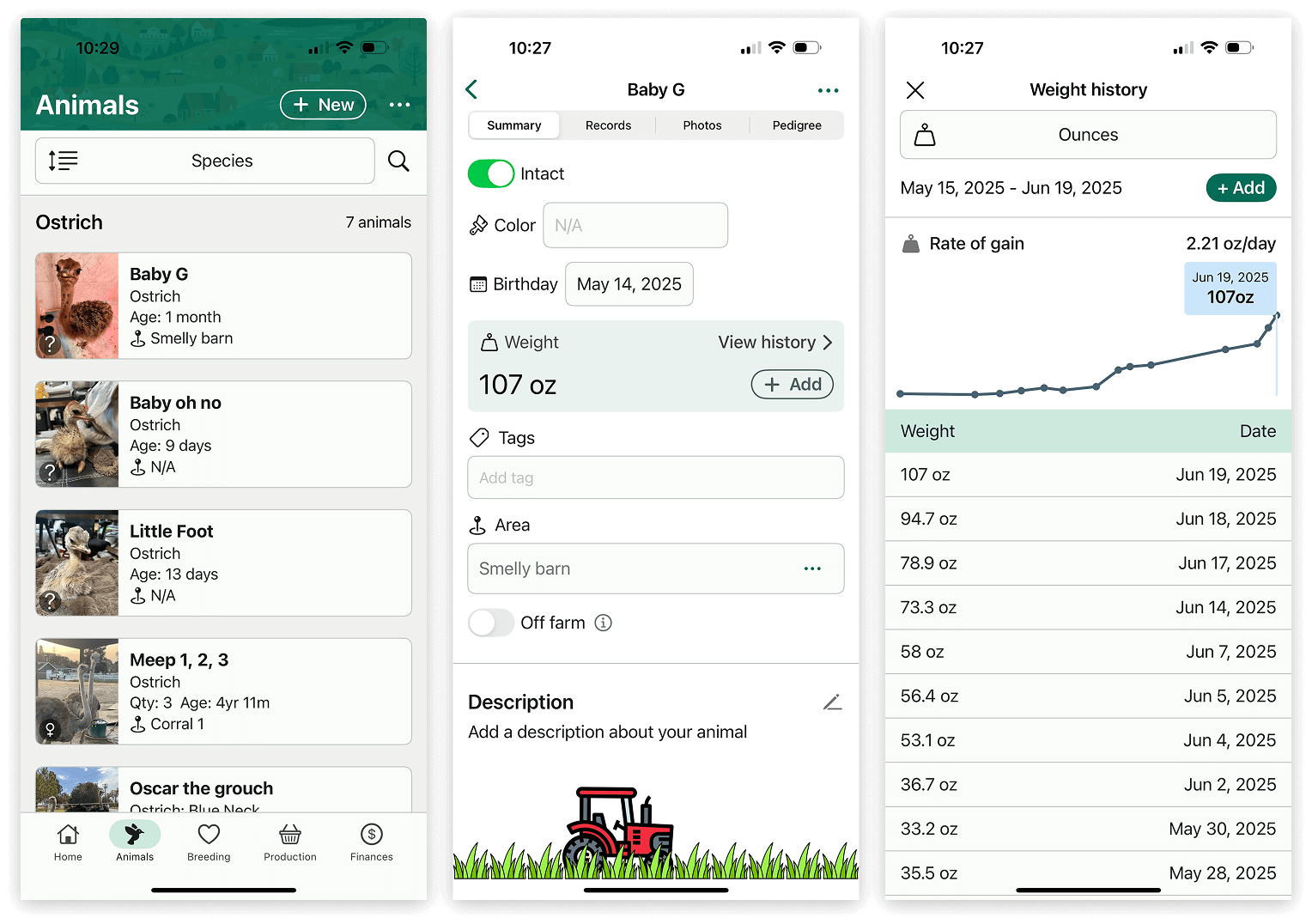
Paper records are prone to error, and spreadsheets can quickly become a mess. That’s why we built FarmKeep—to make livestock tracking smarter and easier. Here's how to use the FarmKeep app to log weights and monitor rate of gain:
Step 1: Add an Animal to Your FarmKeep Inventory
- Log into the app and go to Livestock Inventory
- Add species, breed, tag ID, birthdate, and any relevant notes
Step 2: Record Weight Entries
- Navigate to the animal’s profile
- Click "Add Weight Record"
- Enter the date and weight
- FarmKeep automatically calculates rate of gain based on previous entries
Step 3: View Rate of Gain Over Time
- In each animal’s profile, view a graph of weight history and ADG
- Identify performance trends and outliers with visual data
- Export records for offline access or reporting
Step 4: Make Data-Driven Decisions
- Compare ADG across groups or breeds
- Adjust feed rations or health protocols as needed
- Select top-performing animals for breeding or sale
Understanding and tracking rate of gain is essential for any farmer focused on efficiency, profitability, and animal health. With FarmKeep, you can ditch the spreadsheets and manage your livestock weight history, health, and performance all in one place.
Ready to track your livestock’s progress like a pro?
Download FarmKeep today and start logging weights, calculating rate of gain, and unlocking powerful insights about your animals.
How Farmers Use Rate of Gain to Boost Efficiency, Profitability, and Breeding Success
1. Optimize Sale Timing in Backgrounding and Stocker Operations
Producers buy young animals, raise them, and sell them to feedlots. To make a profit, they need to get the animals to weight quickly and efficiently.
Why Rate of Gain Matters:
- Helps you predict when animals hit target weight classes
- Determines how long to hold animals before sale
- Lets you compare performance across pastures, pens, or feed programs
📲 Tip: Use FarmKeep to log weights across groups and compare ADG between different pasture rotations or supplemental feed programs.
2. Evaluate Forage and Grazing Efficiency
If you’re running a grazing-based operation, your pastures are your feedlot. Monitoring rate of gain helps you understand whether your forage is performing as it should.
How Farmers Use It:
- Track gains during specific grazing periods
- Identify which fields or paddocks yield the best results
- Time rotational grazing more effectively
🌿 Example: If ADG drops in a specific field, it may signal overgrazing, poor regrowth, or low forage quality.
3. Monitor Animal Health and Recovery After Illness
If an animal slows or stops gaining weight, it's often one of the first signs of trouble.
How Rate of Gain Helps:
- Spot health issues early—before symptoms are obvious
- Monitor recovery progress after treatment or stress (like weaning or transport)
- Adjust care plans or vet follow-ups based on data, not guesswork
🐂 FarmKeep lets you attach weight records to health logs so you can track medical history and growth side-by-side.
4. Validate New Feed and Supplement Programs
Before you commit to a new feed mix or supplement, you need to know whether it works. Tracking rate of gain gives you hard numbers to justify the cost.
Key Benefits:
- Measure cost per pound of gain
- Compare different feed types or rations
- Optimize feed for maximum return on investment
💰 Use FarmKeep to track feed costs and weight data. Then, see which rations give the best results for your money
5. Improve Efficiency in Finishing Pigs and Poultry
In species with short production cycles, every day counts. Tracking rate of gain helps you optimize your finishing schedule and keep feed costs low.
Why It’s Critical:
- Ensure animals hit market weight on time
- Reduce feed waste and over-conditioning
- Spot performance dips caused by environmental stress or poor nutrition
🐖 FarmKeep supports batch weight tracking for animals like broilers or market hogs, so you can manage entire groups with ease.
6. Benchmark Performance Across Groups or Barns
If you’re managing livestock across multiple pens, barns, or managers, rate of gain becomes a powerful benchmarking tool.
Use It To:
- Identify top-performing pens or groups
- Evaluate staff performance or SOP adherence
- Standardize best practices across your farm
📊 With FarmKeep, you can group animals by pen, breed, or barn and compare performance across multiple dimensions.
7. Meet Contractual or Program Requirements
Some meat processors or branded programs require animals to reach a specific weight within a certain timeframe.
Why ADG Is Essential:
- Ensures animals meet grade or certification requirements
- Avoids penalties or downgraded pricing
- Helps schedule processing dates with precision
🧾 Tracking ADG helps you deliver consistent results and avoid surprises at the processor.
8. Knowing When Your Animal Is Ready for Butcher
Timing is everything when it comes to finishing livestock for meat. Harvest too early, and you sacrifice valuable weight (and revenue). Wait too long, and you’re throwing money at feed that isn’t adding muscle—just fat.
How rate of gain helps:
- By tracking weight over time, you can estimate how many days until your animal reaches market weight.
- You can avoid guesswork by scheduling processing dates with confidence. This helps ensure animals reach the ideal weight for your buyer or processor.
✍️ Example: If your steer gains 2.8 lbs per day and needs to reach 1,300 lbs, FarmKeep can help. You can use its tracking to find out when to schedule the butcher.
9. Make Smarter Breeding Decisions
Not all genetics are created equal. Rate of gain helps you identify which animals pass on strong growth traits.
How It Improves Breeding:
- Track offspring performance by sire and dam
- Cull slow-growing bloodlines
- Select for feed-efficient, fast-growing genetics
🧬 FarmKeep lets you link weight records to breeding history, so you can evaluate which matings produce the best gains.
10. Tracking 4-H and FFA Project Animals
For young people in 4-H and FFA programs, rate of gain is often a key component of their livestock project. Judges and records books frequently include ADG as part of scoring or evaluation.
How rate of gain helps:
- It teaches youth how to monitor animal health, nutrition, and daily management with real data.
- Helps them build a strong portfolio or presentation for the show ring, demonstrating good animal husbandry and financial responsibility.
✍️ A 4-H student can use FarmKeep to enter weights for check-in and weigh-in. They can also export the data to create an ADG chart for their final project book.
Learn more about how FarmKeep can help 4H students and families.
Track Rate of Gain Easily with FarmKeep
Paper records and spreadsheets can make tracking weight and gain a chore. With the FarmKeep app, you can:
✅ Record weight entries for individuals or groups
✅ Automatically calculate ADG between weigh-ins
✅ Visualize growth curves over time
✅ Compare animals, groups, or breeds
✅ Tie weight data to breeding, feed, and health logs