Cattle Feed Calculator
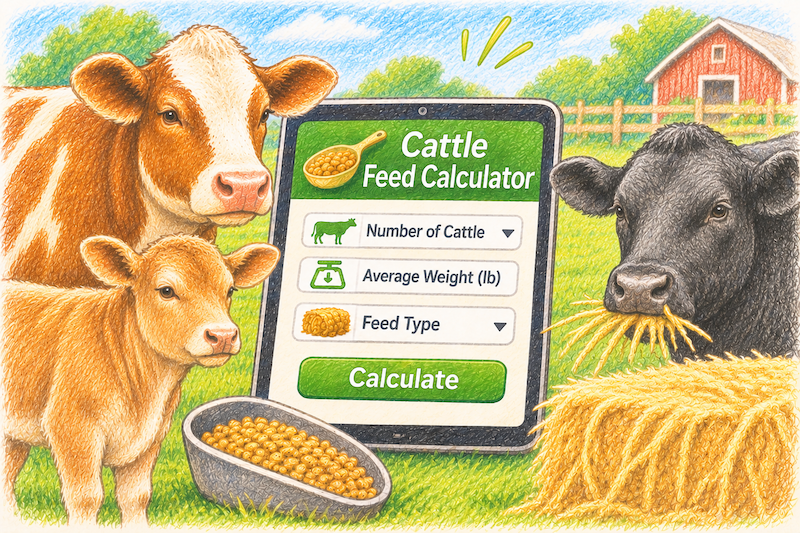
Wondering how much hay your cows need or how many round bales to buy for winter? Our free Cattle Feed Calculator helps you estimate daily feed requirements, hay quantities, feed purchasing needs, and feeding costs for beef and dairy cattle. Whether you're raising a couple of cows on your homestead or managing a larger cattle herd, understanding your animals' feed requirements can help you plan ahead, manage expenses, and avoid running short on hay.
Choose Simple Mode to quickly estimate hay requirements, or use Advanced Mode to plan multiple feed sources, including pasture, grain, silage, and supplements.
How to Use the Cattle Feed Calculator
Our cattle feed calculator estimates how much feed your herd may consume based on body weight, production stage, forage quality, and feeding conditions. You can choose between two calculation modes depending on how detailed you want your feeding plan to be.
Simple Mode: Calculate Cattle Hay Requirements
Simple Mode is ideal for farmers who want to estimate how much hay their cattle need and how many bales to purchase. Start by entering the number of cattle you're feeding, their average weight, and their production stage. Next, select the forage quality, hay type, and how many days you're planning to feed your herd. You can also enter your hay bale weight, price per bale, and existing hay inventory.
The calculator estimates:
- Daily hay requirements per cow.
- Total hay required for your herd.
- How many round or square bales you'll need.
- Additional hay to purchase after accounting for existing inventory.
- Estimated purchasing costs.
Note: Simple Mode assumes hay supplies all of your cattle's estimated dry matter intake. If your cattle also consume pasture, silage, grain, or other feeds, use Advanced Mode for a more customized estimate.
Advanced Mode: Plan Multiple Cattle Feed Sources
Advanced Mode allows you to create a more detailed feed purchasing plan. You can adjust estimated dry matter intake, account for pasture consumption, and include supplemental feeds such as grain, commercial cattle pellets, haylage, or corn silage. Enter the amount of each supplemental feed your cattle already receive, and the calculator will account for its dry matter contribution when estimating the remaining forage quantity. Advanced Mode also provides more control over feed waste, storage losses, inventory, and purchasing costs. The calculator estimates feed quantities and expenses. It does not formulate a nutritionally balanced ration or automatically recommend grain quantities.
How Much Feed Does a Cow Need?
The amount of feed a cow needs depends on several factors, including body weight, age, production stage, forage quality, and environmental conditions. A common way to estimate cattle feed consumption is through dry matter intake (DMI). Dry matter intake measures the amount of feed an animal consumes after removing its water content. For mature beef cows, forage dry matter intake may range from approximately 1.8% to 2.7% of body weight daily under different feeding conditions.
For example, a 1,200-pound non-lactating beef cow consuming average-quality forage at an estimated 2.2% of body weight would consume:
1,200 × 0.022 = 26.4 pounds of dry matter daily.
If the cow receives grass hay containing 90% dry matter:
26.4 ÷ 0.90 = 29.3 pounds of hay consumed daily.
This is the estimated amount actually eaten, before accounting for feed waste. Actual intake can vary significantly, especially for growing cattle, lactating cows, and animals receiving supplemental grain or other feeds.
Cattle Feed Requirements by Type and Forage Quality
Not all cattle consume the same amount of feed relative to their body weight. Forage quality and production stage can significantly affect intake. Mississippi State University Extension provides estimated forage intake capacities for mature beef cows based on forage quality and whether the cow is lactating.
These estimates assume that dietary protein requirements are met and are intended for healthy cattle in good body condition. For example, a lactating beef cow consuming average-quality forage may have a higher estimated intake than a non-lactating cow of the same weight. It's also important to distinguish beef cattle from dairy cattle. A high-producing dairy cow may consume substantially more dry matter than a mature beef cow at maintenance because producing milk increases nutritional demands. For growing, finishing, and dairy cattle, more specific intake estimates may be needed.
How Much Hay Does a Cow Eat Per Day?
Hay is one of the most common stored forages used to feed cattle, especially during winter or when pasture availability is limited. The amount of hay a cow consumes depends on body weight, forage quality, production stage, and the portion of its diet supplied by hay. For general planning, we can estimate hay consumption using the cow's dry matter intake and the moisture content of the hay.
Daily Hay Requirements by Cow Weight
The following examples assume:
- Mature, non-lactating beef cattle.
- Average-quality forage.
- Dry matter intake of 2.2% of body weight.
- Grass hay containing 90% dry matter.
- Hay supplies all estimated dietary dry matter.
- No feed waste included.
These are illustrative planning estimates rather than universal feeding recommendations. For example, a 1,200-pound cow may consume approximately 29.3 pounds of hay daily under these assumptions. However, if 15% of the hay offered is wasted, the farmer would need to provide approximately 34.5 pounds of hay daily to account for those losses.
Does Hay Quality Affect How Much Cattle Eat?
Yes. Hay quality can influence both intake and nutritional value. High-quality forage is often more digestible and may support greater dry matter intake than mature, low-quality forage. But more hay isn't always the solution to inadequate nutrition. Low-quality hay may not provide enough energy or protein, even when cattle have access to large quantities. Forage testing can help farmers understand the nutritional value of their hay and determine whether supplementation may be necessary.
How Many Bales of Hay Do Cattle Need?
One of the most practical reasons to use a cattle feed calculator is figuring out how many bales to buy. Once you know your herd's daily hay requirements, you can calculate the total quantity needed over your feeding period.
Example: How Many Round Bales for Five Cows?
Let's assume you have:
- 5 mature beef cows.
- Average weight of 1,200 pounds.
- Dry matter intake of 2.2%.
- Hay containing 90% dry matter.
- Estimated feeding waste of 15%.
- A 30-day feeding period.
Each cow would consume approximately 29.3 pounds of hay daily.
Accounting for 15% waste: 29.33 ÷ 0.85 = 34.51 pounds of hay offered per cow daily.
For five cows: 34.51 × 5 = 172.55 pounds daily.
Over 30 days: 172.55 × 30 = approximately 5,176 pounds of hay.
If your round bales weigh 1,000 pounds each: 5,176 ÷ 1,000 = 5.18 bales.
Round up to the next whole bale. Estimated purchase: 6 round bales.
How Much Does Bale Weight Matter?
Not all round bales weigh the same amount. Bale weight can vary depending on size, forage type, moisture content, and baling density. A farmer purchasing 800-pound bales may need more bales than someone purchasing 1,200-pound bales, even when both are feeding the same herd. For more accurate purchasing estimates, use the actual average weight of your hay bales rather than relying on bale dimensions alone.
How to Calculate Cattle Feed Requirements
Cattle feed requirements can be estimated using body weight, dry matter intake, feed moisture, feeding losses, and the number of animals. Here's how the calculation works.
Step 1: Calculate Daily Dry Matter Intake
Multiply the animal's body weight by its estimated daily dry matter intake percentage. Daily Dry Matter Intake = Body Weight × DMI Percentage
For a 1,200-pound cow consuming 2.2% of body weight: 1,200 × 0.022 = 26.4 pounds of dry matter daily.
Step 2: Convert Dry Matter Into Hay Weight
Hay contains some moisture, so the actual amount of hay needed will be greater than the dry matter requirement. Hay Consumed = Daily Dry Matter Intake ÷ Hay Dry Matter Percentage
With hay containing 90% dry matter: 26.4 ÷ 0.90 = 29.33 pounds of hay daily.
Step 3: Account for Feeding Waste
Some hay may be lost through trampling, contamination, or spillage. Hay Offered = Hay Consumed ÷ (1 − Feeding Waste Percentage)
With 15% waste: 29.33 ÷ 0.85 = 34.51 pounds of hay offered daily. Here, waste is defined as the portion of feed offered that isn't consumed.
Step 4: Calculate Total Herd Requirements
Multiply daily hay offered by the number of cattle and feeding days. Total Hay Required = Daily Hay Offered × Number of Cattle × Feeding Days
For five cows over 30 days: 34.51 × 5 × 30 = approximately 5,176 pounds of hay.
Step 5: Estimate Bales to Purchase
Divide the total hay requirement by the weight of each bale. Bales Needed = Total Hay Required ÷ Bale Weight
Round up to a whole bale. If you have existing hay inventory, subtract usable inventory from your purchasing requirement.
Step 6: Calculate Feed Costs
Multiply the number of additional bales you need to purchase by the price per bale.
If you need six bales at $75 each: 6 × $75 = $450 in estimated hay purchases.
This example excludes transportation, equipment, labor, and other feeding-related expenses.
Understanding Dry Matter Intake in Cattle
Dry matter intake is an important concept in cattle nutrition because different feeds contain different amounts of water. For example, dry hay may contain approximately 90% dry matter, while corn silage may contain only about 35%. This means cattle must consume different as-fed weights to obtain the same amount of dry matter.
Dry Matter Content of Common Cattle Feeds
These are example values, not guaranteed feed specifications. Actual moisture levels vary by feed type, harvest conditions, processing, and storage.
Why Does Dry Matter Matter?
Imagine a cow needs 25 pounds of dry matter daily.
If the cow receives hay containing 90% dry matter: 25 ÷ 0.90 = 27.8 pounds of hay.
If the cow receives corn silage containing 35% dry matter: 25 ÷ 0.35 = 71.4 pounds of silage.
Both amounts provide 25 pounds of dry matter, but they don't necessarily provide the same nutritional value. Dry matter describes feed weight excluding water. It doesn't tell you whether a feed provides adequate protein, energy, fiber, or minerals. A forage analysis is useful when evaluating the nutritional quality of your cattle feed.
Feeding Beef Cattle vs. Dairy Cattle
Beef and dairy cattle have different nutritional requirements depending on their production goals.
Beef Cattle Feeding Requirements
Beef cattle feeding programs may focus on maintaining body condition, supporting pregnancy and lactation, or promoting growth. For example, mature beef cows at maintenance typically have lower nutritional demands than growing or lactating animals. Stocker and finishing cattle may consume diets designed to support specific growth objectives. Their feed requirements depend on body weight, desired performance, and diet composition.
Dairy Cattle Feeding Requirements
Lactating dairy cows have higher nutritional demands because producing milk requires substantial amounts of energy, protein, and other nutrients. Their dry matter intake may be considerably higher than that of a non-lactating beef cow. Dairy feeding programs must also consider forage quality, milk production, feed digestibility, and nutrient balance. For this reason, the FarmKeep calculator allows users to adjust estimated intake for different cattle categories. It doesn't replace a dairy ration formulation program.
How Much Grain Should You Feed Cattle?
Grain and other concentrated feeds may be used in cattle feeding programs to provide additional energy or nutrients. However, there isn't a single grain quantity suitable for every cow.
The appropriate amount depends on:
- Body weight and age.
- Beef or dairy production.
- Growth or milk production goals.
- Forage quality and availability.
- The composition of the grain or concentrate.
- The overall nutritional balance of the diet.
Can Grain Replace Hay?
Grain and hay both contribute dry matter, but they aren't nutritionally interchangeable. Hay provides physically effective fiber that supports normal rumen function. Grain-heavy diets require careful formulation and management because excessive rapidly fermentable carbohydrates can contribute to digestive disorders, including ruminal acidosis.
How FarmKeep Calculates Grain and Supplemental Feeds
In Advanced Mode, you can enter the amount of grain, commercial cattle pellets, or other supplemental feed you already provide. The calculator estimates the dry matter supplied by those feeds and accounts for that contribution when estimating the remaining forage quantity. You can also enter feed prices to estimate purchasing costs.
Important: This is a feed quantity calculation, not a recommendation that the resulting ration is nutritionally appropriate. Consult a qualified cattle nutritionist when developing or changing feeding programs.

How Much Hay Do You Need for Cattle in Winter?
Winter feeding can represent a substantial expense for cattle owners, especially in regions where pasture growth slows or stored forage is needed for several months. Planning hay requirements before winter can help prevent feed shortages and make purchasing more predictable.
Example: Winter Hay Requirements for 10 Cows
Assume:
- 10 mature beef cows.
- Average weight of 1,200 pounds.
- Average-quality forage.
- Estimated DMI of 2.2%.
- Hay containing 90% dry matter.
- Feeding waste of 15%.
- Winter feeding period of 120 days.
Each cow requires approximately 34.51 pounds of hay offered daily, including waste.
For 10 cows: 34.51 × 10 = approximately 345.1 pounds daily.
Over 120 days: 345.1 × 120 = approximately 41,412 pounds of hay.
For 1,000-pound round bales: 41,412 ÷ 1,000 = 41.41 bales.
Estimated purchase: 42 round bales.
This estimate accounts for the specified feeding waste but not additional storage losses. It also assumes the cows' weight, intake, and feed conditions remain constant.
Account for Existing Hay Inventory
If you already have 15 usable round bales in storage: 42 − 15 = 27 additional bales needed.
This is where feed inventory planning becomes particularly useful. Instead of simply estimating how much hay your cattle will consume, you can calculate how much additional feed you need to purchase.
Don't Forget Storage Losses
Hay stored outdoors may experience losses due to rain, moisture, ground contact, or spoilage. The amount lost depends on storage conditions and how long the hay remains in storage. If storage losses are significant, farmers may need to purchase additional hay beyond the calculated feeding requirement. The calculator's Advanced Mode can help account for these losses separately from feeding waste.
How Feed Waste Affects Cattle Feeding Costs
Feed waste can increase the amount of hay farmers need to purchase. Hay may be lost during storage, handling, and feeding.
Common causes include:
- Cattle trampling hay.
- Hay becoming contaminated with manure or urine.
- Excessive spillage from feeders.
- Weather exposure.
- Improper bale storage.
- Spoilage.
Example: How Waste Changes Hay Requirements
Imagine your cattle actually consume 10,000 pounds of hay over a feeding period.
If 5% of the hay offered is wasted, you would need approximately 10,526 pounds available for feeding.
At 15% waste, that increases to approximately 11,765 pounds.
At 25% waste, you'd need approximately 13,333 pounds.
Reducing feeding losses can make a substantial difference in hay purchasing costs.
Tips for Reducing Hay Waste
Use appropriate hay feeders. Research has shown that feeder design can influence hay losses, particularly when feeding large round bales.
Store hay properly. Protect hay from excessive moisture and avoid prolonged ground contact when possible.
Monitor actual intake. Compare the hay offered with the amount cattle consume or waste.
Evaluate forage quality. Forage testing can help identify nutritional deficiencies and guide feeding decisions.
Keep feeding records. Tracking feed purchases, quantities, and costs can help farmers identify trends and plan future purchases more effectively.
More Livestock Calculators
Managing more than cattle? Explore FarmKeep's free livestock tools to help plan feed quantities and expenses.
Simplify Cattle Management with FarmKeep
Knowing how much feed your cattle need is a great start. But managing a herd involves a lot more than figuring out how many hay bales to buy. FarmKeep helps you keep your cattle records organized, track feeding activities, record farm expenses, manage breeding, and stay on top of important livestock tasks. Whether you're raising a couple of cows on your homestead or managing a growing cattle operation, FarmKeep gives you the tools to keep everything in one place.
Less paperwork. More time with your herd. Get Started with FarmKeep →
Sources & References
The calculator's methodology and general feeding estimates are informed by agricultural extension and veterinary resources, including:
- Mississippi State University Extension — Beef Cattle Nutrient Requirements
- Oregon State University Extension — Understanding Your Forage Test Results
- University of Illinois Extension — Winter Feeding
- University of Illinois Extension — Reducing Hay Waste
- University of Illinois Extension — Bale Feeder Design
- Penn State Extension — Feed Inventory for the Dairy Herd: Planning for Shortages
Disclaimer: This calculator provides general estimates for cattle forage consumption, feed purchasing, and costs. Actual feeding requirements vary with animal weight, age, production stage, health, forage quality, and environmental conditions. It does not formulate nutritionally balanced rations or replace professional cattle nutrition guidance.
FAQ
How much hay does a cow eat per day?
Daily hay consumption depends on body weight, production stage, and forage quality. For example, a 1,200-pound non-lactating beef cow consuming 2.2% of body weight in dry matter would consume approximately 29.3 pounds of hay daily if the hay contains 90% dry matter and supplies all estimated dietary dry matter.
How much hay do 10 cows need for winter?
Using the example of ten 1,200-pound beef cows consuming average-quality hay, with 15% feeding waste, a 120-day feeding period requires approximately 41,412 pounds of hay, or 42 round bales weighing 1,000 pounds each. Actual requirements vary.
How many round bales does one cow need per month?
A 1,200-pound cow requiring approximately 34.5 pounds of hay offered daily would need around 1,035 pounds over 30 days. That's slightly more than one 1,000-pound bale, so two whole bales would be needed if purchasing solely for that cow and period.
How much does it cost to feed a cow per day?
Daily feeding costs depend on the quantity and price of feed, production stage, and feeding losses. For example, if a cow is allocated 34.5 pounds of hay daily and hay costs $75 per 1,000-pound bale, the estimated hay value is approximately $2.59 per cow per day before additional expenses and whole-bale purchasing adjustments.
What percentage of body weight should cattle eat daily?
For mature beef cows, estimated forage dry matter intake can range from approximately 1.8% to 2.7% of body weight depending on forage quality and lactation status. Growing cattle and dairy cows may require different intake assumptions.
How much grain should I feed beef cattle?
There is no universal grain quantity suitable for all beef cattle. The amount depends on body weight, forage quality, production goals, and the nutritional composition of the total ration. Grain should be incorporated into an appropriate feeding program.
Do dairy cows need more feed than beef cows?
Lactating dairy cows often have higher dry matter and nutrient requirements because of milk production. Actual intake depends on milk yield, body weight, diet quality, and other factors. Dry dairy cows may have much lower requirements than lactating cows.
What is dry matter intake in cattle?
Dry matter intake is the amount of feed cattle consume after excluding water. It helps farmers compare feeds with different moisture contents and estimate quantities needed for feeding.
How can I reduce hay waste when feeding cattle?
Using suitable feeders, protecting hay from moisture, monitoring consumption, and improving storage practices can help reduce losses. The amount saved depends on your feeding system and management practices.
Can I calculate hay requirements if my cattle also graze pasture?
Yes. Advanced Mode allows you to estimate the portion of total dry matter intake supplied by pasture. The calculator then estimates how much additional stored forage may be needed. Actual pasture consumption can be difficult to measure, so the result should be treated as a planning estimate.