This article is intended for educational purposes and is not a substitute for veterinary diagnosis or treatment. Drug approvals, recommended uses and withdrawal periods can change. Work with your veterinarian to determine an appropriate parasite-control and deworming program for your herd.
Goat Dewormer Guide: How to Choose & Use Dewormers for Goats
Choosing a goat dewormer isn’t as simple as picking the strongest-looking product on the feed store shelf. Goat owners may encounter products containing fenbendazole, moxidectin, ivermectin, albendazole, levamisole, morantel and other active ingredients—but there isn’t one dewormer that is best for every goat or every farm.
Internal parasites have developed resistance to commonly used dewormers, and the degree of resistance can vary considerably between farms. A product that still works well in one herd may perform poorly in another.
Modern parasite management therefore focuses on three questions: Does this goat actually need treatment? Which dewormer is appropriate? And does that dewormer still work against the parasites on your farm?
What Is the Best Dewormer for Goats?
There is no single best dewormer for goats. The appropriate treatment depends on several factors, including the parasites involved, the health and reproductive status of the animal, how the product is being used, and whether the parasite population on the farm is still susceptible to that drug. Dewormer resistance is widespread in small-ruminant parasites, and resistance has been documented across the major classes of dewormers used in sheep and goats.
That means choosing a goat wormer based solely on brand reputation—or because another goat owner says it works well for their herd—can be misleading. A more useful question is: Which dewormer is appropriate for this situation, and is it still effective against the parasites on my farm?
Answering that question requires understanding the different dewormers available, monitoring your goats for parasite problems, and periodically evaluating whether treatments are actually working.
Common Goat Dewormers
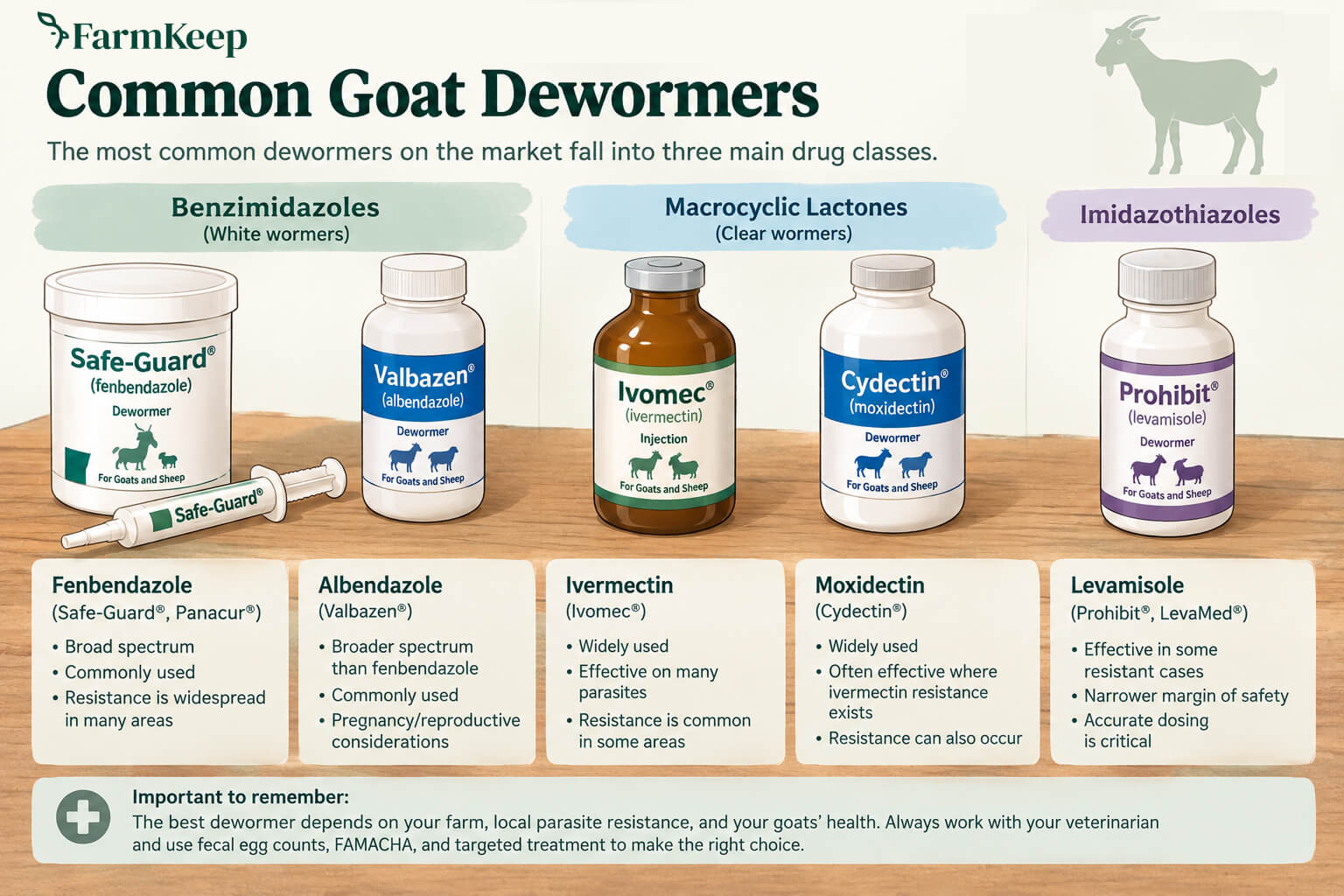
Dewormers, also called anthelmintics, are drugs used to control parasitic worms. Several active ingredients and drug classes are commonly encountered in goat parasite management. You may recognize the brand name on the bottle before you recognize the active ingredient, but the active ingredient and drug class are important because resistance generally affects drugs within related classes.
This table is intended to help goat owners understand common dewormer terminology. It is not a treatment or dosing chart. Product labeling, approved uses, withdrawal periods and veterinary requirements vary. Work with your veterinarian to determine which treatment is appropriate for your goats.
Fenbendazole: Safe-Guard and Panacur for Goats
Fenbendazole belongs to the benzimidazole class of dewormers. Goat owners commonly encounter it under brand names including Safe-Guard and Panacur.
Fenbendazole is one of the most familiar goat dewormers, but familiarity doesn’t guarantee effectiveness. Resistance to benzimidazole dewormers is common in small-ruminant parasites, so the fact that a product contains fenbendazole does not mean it will reliably control the parasites on every farm.
Safe-Guard and Panacur are brand names; fenbendazole is the active ingredient. This distinction becomes important when comparing products or reviewing the history of dewormers used in a herd.
Moxidectin: Cydectin for Goats
Cydectin is a brand associated with moxidectin, which belongs to the macrocyclic lactone group of dewormers. Goat owners researching Cydectin should pay close attention to the specific formulation being discussed. Products sold under the same general brand family may be formulated and labeled for different species or routes of administration.
Resistance can also affect moxidectin. It should not be viewed as an automatically stronger solution when another dewormer fails. The appropriate product, formulation, route and use should be determined with veterinary guidance.
Ivermectin: Ivomec for Goats
Ivermectin is another member of the macrocyclic lactone group and is commonly recognized through brands such as Ivomec as well as numerous generic products. Ivermectin has historically been used extensively in livestock parasite control. That long history of use has also created substantial selection pressure, and resistant gastrointestinal parasites are common on many sheep and goat farms.
If ivermectin has been used repeatedly on a farm, treatment history alone cannot tell you whether it remains effective. Fecal egg count reduction testing can provide much more useful information.
Albendazole: Valbazen for Goats
Albendazole, commonly associated with the brand Valbazen, is another benzimidazole dewormer. Although albendazole and fenbendazole are different active ingredients, they belong to the same major drug class. Resistance within a drug class is therefore an important consideration when evaluating treatment options.
Albendazole also has important reproductive-use considerations. Product selection for pregnant animals should be discussed with a veterinarian rather than based on a generic online deworming schedule.
Levamisole: Prohibit and LevaMed
Levamisole belongs to a different major anthelmintic group from fenbendazole, albendazole, ivermectin and moxidectin. Goat owners may encounter it under names such as Prohibit or LevaMed. Accurate animal weight and dosing are particularly important with levamisole because its margin of safety is narrower than that of some other dewormers.
This is another reason a goat deworming program should not simply consist of rotating through whatever products happen to be available.
Morantel: Rumatel
Morantel is commonly encountered under the Rumatel name and is available in some feed-based products labeled for goats. Concentrations can vary considerably between products, making it especially important to read the actual product label rather than assuming all products containing the same active ingredient are interchangeable.

When Should You Deworm a Goat?
Current small-ruminant parasite-management recommendations have moved away from automatically deworming goats every few weeks or months. Likewise, routinely deworming every goat in a herd at the same time is generally discouraged.
Instead, the goal is targeted selective treatment: identifying animals that actually require or are most likely to benefit from treatment while leaving healthier animals untreated.
Depending on the parasites involved and conditions on the farm, treatment decisions may consider:
- FAMACHA score
- Bottle jaw
- Body condition
- Weight loss or poor growth
- Diarrhea or fecal soiling
- Hair coat and general condition
- Fecal testing
- Age
- Pregnancy or lactation
- Previous parasite problems
- Other signs of illness
No single measurement tells the whole story. For example, FAMACHA is particularly useful for assessing anemia associated with barber pole worm, but it does not detect every type of gastrointestinal parasite. Likewise, fecal egg counts provide information about parasite egg shedding but there is no universal eggs-per-gram threshold at which every goat should automatically be dewormed. The goal is to build a picture of the individual animal, rather than treating the calendar.
Why Dewormer Resistance Matters in Goats
One of the biggest challenges in goat parasite control is anthelmintic resistance. An important distinction is: The goat doesn’t become resistant to the dewormer. The worms do. Within a parasite population, some worms may carry traits that allow them to survive a particular drug. When a dewormer is administered, susceptible worms are killed while resistant worms are more likely to survive.
Those survivors reproduce. Over repeated treatments, the proportion of resistant parasites can increase:
- Dewormer is administered
- Susceptible worms are killed
- Resistant worms survive
- Survivors reproduce
- Resistance becomes increasingly common
This process is one reason repeated blanket deworming can create problems over time.
What Is Refugia?
Refugia refers to the portion of the parasite population that has not been exposed to a dewormer. This can include worms living in untreated animals as well as parasite stages in the environment. Why would you want susceptible worms around at all? Because those susceptible parasites can reproduce with resistant parasites, helping dilute resistance genes within the overall population. Targeted selective treatment helps preserve refugia by treating animals that need treatment while leaving others untreated.
The objective isn’t to create a completely worm-free herd. In most grazing systems, that isn’t realistic. The objective is to prevent parasites from causing unacceptable disease while preserving the effectiveness of the treatments that remain available.
Why Goat Dewormer Dosing Can Be Complicated
Searching online for a goat dewormer often leads quickly to dosing charts. Unfortunately, goat dewormer dosing isn’t always straightforward. Products may be formulated or labeled for goats, sheep, cattle, horses or other species. Goats can metabolize some drugs differently from other livestock, and many dewormer uses in goats may fall under extra-label drug use.
Other factors also matter:
- The goat’s actual weight
- Active ingredient
- Product concentration
- Formulation
- Route of administration
- Pregnancy or lactation
- Meat withdrawal periods
- Milk withdrawal periods
- Parasite involved
- Resistance on the farm
Underdosing can contribute to treatment failure and selection for resistant parasites. Overdosing can create safety concerns.
This is why a generic internet dosing chart should not replace veterinary guidance. In the United States, extra-label drug use in food-producing animals is regulated and requires veterinary oversight. Work with your veterinarian to determine the appropriate product, dose, route and withdrawal period for your animals.
Should You Rotate Dewormers for Goats?
For years, goat owners were often advised to rotate between dewormer classes to prevent resistance.
For example: Dewormer A → Dewormer B → Dewormer C → repeat
That strategy is no longer considered an effective way to prevent resistance. Rotating products simply exposes the parasite population to different drugs over time and does not prevent resistant worms from being selected. Current small-ruminant parasite-management guidance instead emphasizes strategies such as:
- Targeted selective treatment
- Maintaining refugia
- Determining which dewormers remain effective
- Avoiding unnecessary treatments
- Monitoring treatment effectiveness
- Using combination treatments when appropriate under professional guidance
Current guidance from the American Consortium for Small Ruminant Parasite Control also supports the use of multiple effective drug classes together in certain circumstances rather than simply rotating from one drug to another. That does not mean goat owners should begin combining dewormers on their own. Drug selection, dosing, safety, withdrawal periods and resistance patterns all need to be considered.
How Do You Know if a Goat Dewormer Worked?
Giving a goat a dewormer doesn’t prove the treatment worked. A goat may appear better after treatment while resistant parasites remain. Conversely, an animal that remains unwell may have another health problem entirely. One of the best tools for evaluating dewormer effectiveness is a fecal egg count reduction test (FECRT).
The basic process is:
- Pre-treatment fecal egg count
- Deworming treatment
- Post-treatment fecal egg count
- Compare the results
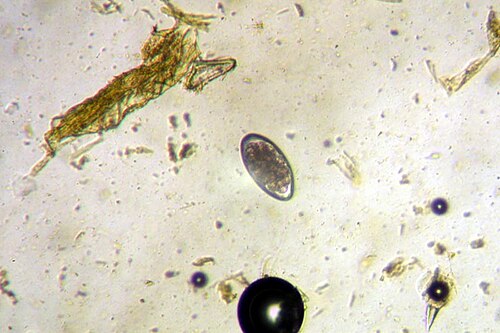
A quantitative fecal egg count measures parasite eggs per gram of manure, or EPG. Comparing counts before and after treatment allows the percentage reduction in egg shedding to be calculated. A smaller-than-expected reduction can raise concern that the parasites are resistant to the dewormer, although sample timing, treatment administration, starting egg counts and laboratory methodology can also affect the result. FECRT is particularly valuable because it replaces: “I think this wormer still works.” with actual information about how the parasite population responded.
Goat Dewormers and Barber Pole Worm
One parasite deserves particular attention when discussing goat dewormers: barber pole worm (Haemonchus contortus). Barber pole worms live in the abomasum and feed on blood. Heavy infections can cause significant anemia, weakness, poor performance and swelling beneath the jaw known as bottle jaw. Severe infections can be fatal.
Because barber pole worm feeds on blood, an infected goat may be seriously affected without developing the diarrhea many owners associate with intestinal worms. Barber pole worm has also developed substantial resistance to dewormers, making targeted treatment and monitoring especially important.
Related guide: Barber Pole Worm in Goats: Symptoms, Testing & Treatment
Related guide: Bottle Jaw in Goats: Causes, Symptoms & What to Do
Can FAMACHA Tell You When to Deworm?
FAMACHA can be an important part of targeted selective treatment where barber pole worm is a concern. The system evaluates the color of the mucous membrane inside the lower eyelid and assigns a score from 1 to 5 corresponding to increasing levels of anemia. But FAMACHA is not a general worm test. A useful way to distinguish three common parasite-management tools is:
Used together with clinical observations and veterinary guidance, these tools provide much more information than simply deworming every animal on a schedule.
Related guide: FAMACHA Score: How to Use FAMACHA for Goats & Sheep
What About Natural Dewormers for Goats?
Interest in natural goat dewormers has grown as owners look for ways to reduce reliance on conventional anthelmintic drugs. Products and approaches commonly discussed include herbal preparations, diatomaceous earth, copper oxide wire particles and tannin-containing plants or forages. These approaches shouldn’t all be treated as equivalent. Some non-drug parasite-management strategies have been studied scientifically. For example, researchers have investigated copper oxide wire particles and condensed-tannin-containing forages as tools within integrated parasite-control programs. That does not mean every herbal product marketed as a “natural dewormer” has been demonstrated to control parasites effectively.
Likewise, something being natural does not automatically make it safer. Copper, for example, is an essential mineral but can become toxic when animals receive too much. Sheep are particularly sensitive to copper, which becomes important on farms raising multiple small-ruminant species. The useful question isn’t: Is this dewormer natural? It’s: What evidence shows that this approach is effective and safe? Natural and management-based parasite-control strategies may eventually reduce reliance on dewormers, but they shouldn’t be assumed to replace effective treatment when an animal is clinically affected by parasites.
Deworming Isn’t the Same as Parasite Management
Dewormers are only one part of controlling parasites. A dewormer treats parasites currently affecting an animal. A parasite-management program tries to reduce how often parasites cause serious disease in the first place.
Depending on the farm, integrated parasite management may include:
- Targeted selective treatment
- FAMACHA monitoring
- Fecal testing
- Pasture and grazing management
- Appropriate stocking density
- Good nutrition
- Biosecurity when introducing new animals
- Monitoring young and otherwise vulnerable animals
- Maintaining refugia
- Selecting breeding animals with greater parasite resistance or resilience
- Testing whether dewormers remain effective
Individual goats also differ considerably in their susceptibility to parasites. One animal may repeatedly require treatment while another of similar age living on the same pasture maintains good condition. Keeping records can help those patterns become visible.
Keep Goat Deworming Records
A deworming record should contain more than the name of the product you used.
Useful information can include:
- Animal name or ID
- Date
- Weight
- Reason for treatment
- FAMACHA score
- Bottle jaw or other observations
- Fecal egg count
- Dewormer or active ingredient
- Treatment details
- Follow-up date
- Follow-up fecal result
- Response to treatment
- Notes
Over time, this creates a much more useful history: Parasite check → Fecal result → Treatment → Follow-up → Response
Instead of trying to remember whether a particular doe received Cydectin or Safe-Guard sometime last summer, you can look back at what was used, why it was used, and what happened afterward. That history can also help identify animals that repeatedly struggle with parasites and dewormers that may no longer be performing as expected.
FAQ
What is the best dewormer for goats?
There isn’t one universally best goat dewormer. Effectiveness depends partly on which parasites are involved and whether the parasite population on your farm remains susceptible to the drug. Work with your veterinarian to select an appropriate treatment and periodically evaluate whether the dewormers you use remain effective.
What are the most common goat dewormers?
Active ingredients commonly encountered in goat parasite management include fenbendazole, albendazole, ivermectin, moxidectin, levamisole and morantel. Brand names include Safe-Guard, Panacur, Valbazen, Ivomec, Cydectin, Prohibit, LevaMed and Rumatel. Labeling and approved uses differ between products.
How often should you deworm goats?
There is no universal schedule for deworming goats. Current small-ruminant parasite-management recommendations favor treating animals based on need rather than automatically deworming the entire herd on a calendar schedule.
Is Safe-Guard a goat dewormer?
Safe-Guard is a brand associated with fenbendazole. Some Safe-Guard products are labeled for goats, but formulation and label instructions matter. Resistance to fenbendazole is common on many small-ruminant farms, so product availability does not guarantee that it will be effective against the parasites in a particular herd.
What is fenbendazole used for in goats?
Fenbendazole is a benzimidazole anthelmintic used to control certain internal parasites. Which parasites it controls, whether it remains effective on a particular farm, and how it should be used depend on the product, resistance patterns and veterinary guidance.
Can Cydectin be used for goats?
Cydectin is a brand associated with moxidectin, but different Cydectin formulations are intended for different species and routes of administration. Do not assume that different formulations are interchangeable. Consult your veterinarian before using moxidectin in goats.
Can ivermectin be used for goats?
Ivermectin has been used in goat parasite management, but many uses may involve veterinary-directed extra-label use, and resistance is common among small-ruminant gastrointestinal parasites. Veterinary guidance is important for determining whether it is appropriate and how it should be used.
What is Valbazen used for in goats?
Valbazen contains albendazole, a benzimidazole anthelmintic. Albendazole has important use considerations, including reproductive considerations, and should be used under appropriate veterinary guidance.
Should you rotate dewormers for goats?
Routine rotation between dewormer classes simply to prevent resistance is no longer recommended. Current parasite-management strategies emphasize targeted selective treatment, maintaining refugia and knowing which drugs remain effective on the farm.
How do you know if a goat dewormer worked?
A fecal egg count reduction test, or FECRT, can help evaluate dewormer effectiveness by comparing parasite egg counts before and after treatment. Clinical improvement alone does not provide the same information about drug efficacy.
Can goats become resistant to dewormers?
The goat itself does not become resistant. The parasite population develops resistance to the drug. Resistant worms survive treatment and reproduce, making the dewormer progressively less effective.
Should you deworm every goat in the herd?
Not automatically. Targeted selective treatment focuses treatment on animals that need or are most likely to benefit from it. Treating an entire herd unnecessarily increases selection pressure for dewormer resistance.
Do natural goat dewormers work?
It depends on the specific approach. Some non-drug parasite-management tools have scientific evidence behind them, while many commercial or homemade “natural dewormer” claims have limited evidence. Evaluate individual methods based on research rather than assuming that all natural products are either effective or ineffective.
Sources & Further Reading
The following veterinary and university resources were referenced in preparing this guide:
- American Consortium for Small Ruminant Parasite Control (ACSRPC/WormX) — Best Management Practices
- American Consortium for Small Ruminant Parasite Control — Combination Dewormers
- American Consortium for Small Ruminant Parasite Control — FAMACHA & Targeted Selective Treatment
- Cornell University College of Veterinary Medicine — Dewormer Chart for Goats
- University of Maryland Extension — When Should I Deworm My Sheep/Goats?
- Penn State Extension — Does My Dewormer Still Work?