This article is intended for educational purposes and is not a substitute for veterinary diagnosis or treatment. FAMACHA should be used with proper training and an official scoring card. Contact your veterinarian if you are concerned about the health of a sheep or goat.
FAMACHA Score: How to Use FAMACHA for Goats & Sheep
FAMACHA© is a system used by sheep and goat producers to assess anemia by examining the color of the mucous membrane inside the lower eyelid. It is particularly useful for managing barber pole worm (Haemonchus contortus), a blood-feeding gastrointestinal parasite that can cause severe anemia and potentially fatal disease.
The FAMACHA system assigns animals a score from 1 to 5. A score of 1 represents a non-anemic animal with redder eyelid tissue, while a score of 5 represents severe anemia with very pale or white tissue.
FAMACHA can help producers identify individual sheep or goats that may require treatment rather than automatically deworming an entire herd or flock. That makes it an important tool in targeted parasite management and in efforts to slow the development of dewormer resistance.
There is one important limitation to understand from the beginning: FAMACHA does not tell you whether an animal has worms in general. It assesses anemia.
What Is FAMACHA?
The FAMACHA system was developed in South Africa as a practical method for assessing anemia associated with barber pole worm in sheep and goats.
Barber pole worms live in the abomasum, one of the compartments of the ruminant stomach, where they feed on blood. When an animal carries a heavy infection, continued blood loss can result in significant anemia. One place this anemia becomes visible is in the mucous membrane, or conjunctiva, inside the lower eyelid.
FAMACHA provides a standardized method for comparing the color of this tissue against an official five-category score card. The system also supports a parasite-management strategy known as targeted selective treatment. Instead of routinely treating every animal with a dewormer, producers evaluate individual animals and treat those that need treatment.
Reducing unnecessary deworming helps maintain a population of parasites that has not been exposed to the drug—a concept known as refugia—and can help slow the development of dewormer resistance.
What Do FAMACHA Scores 1–5 Mean?
FAMACHA scores range from 1 to 5, representing increasing levels of anemia.
The official FAMACHA card also uses carefully standardized colors corresponding to each category. Those colors are an important part of the scoring system and should not be recreated from the descriptions above.
Goats and sheep can also differ somewhat in the appearance of their eyelids. Healthy goats are less likely than sheep to display the deepest red associated with a FAMACHA score of 1, making proper training particularly important when using the system with goats.
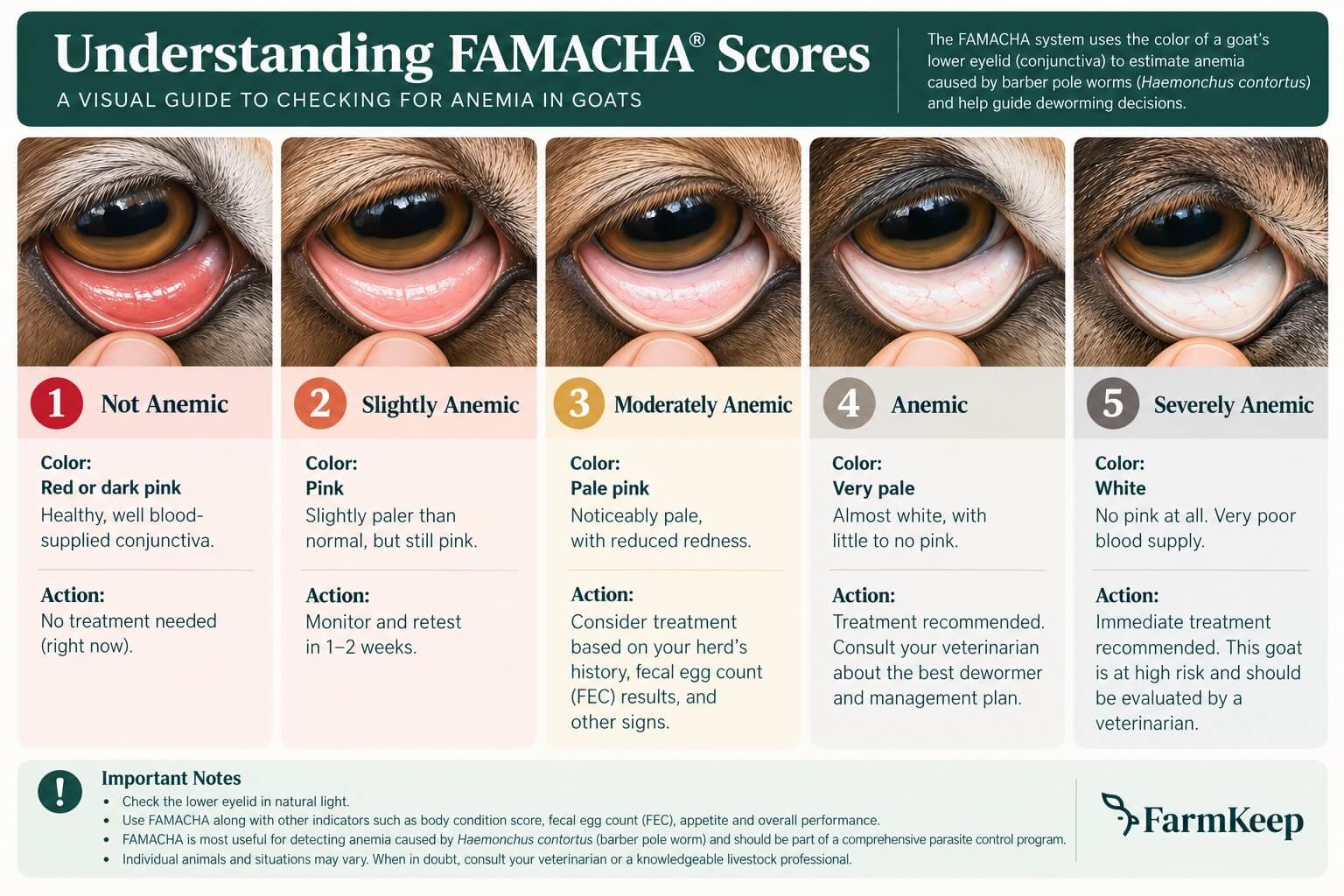
FAMACHA Card for Goats & Sheep
The official FAMACHA score card contains five standardized color categories that are compared directly with the conjunctiva inside the animal’s lower eyelid.
The card should be held near the eye so the producer can compare the animal’s mucous membrane with the official colors.
Can You Print a FAMACHA Score Card?
Although images and reproductions of FAMACHA cards can be found online, a home-printed FAMACHA score card should not be used as a substitute for the official card.
The colors on an official card are specifically produced for the scoring system. Colors can change when an image is photographed, scanned, displayed on different screens or reproduced by different printers.
A printed copy that looks close to the original may still be different enough to influence the score you assign.
The FAMACHA card is also copyrighted, so freely distributing reproductions may raise additional issues.
Online images are useful for understanding what a FAMACHA card looks like and how the system works, but they should not become the color reference used to evaluate an animal.
Where Can You Get an Official FAMACHA Card?
Official FAMACHA cards are generally provided in association with FAMACHA training. In the United States, the American Consortium for Small Ruminant Parasite Control provides information about FAMACHA training and certification resources.
Training matters because accurate FAMACHA scoring involves more than owning the card. Producers also need to know how to expose the correct tissue, distinguish it from other parts of the eye, compare the color correctly and interpret the score in the context of the animal.
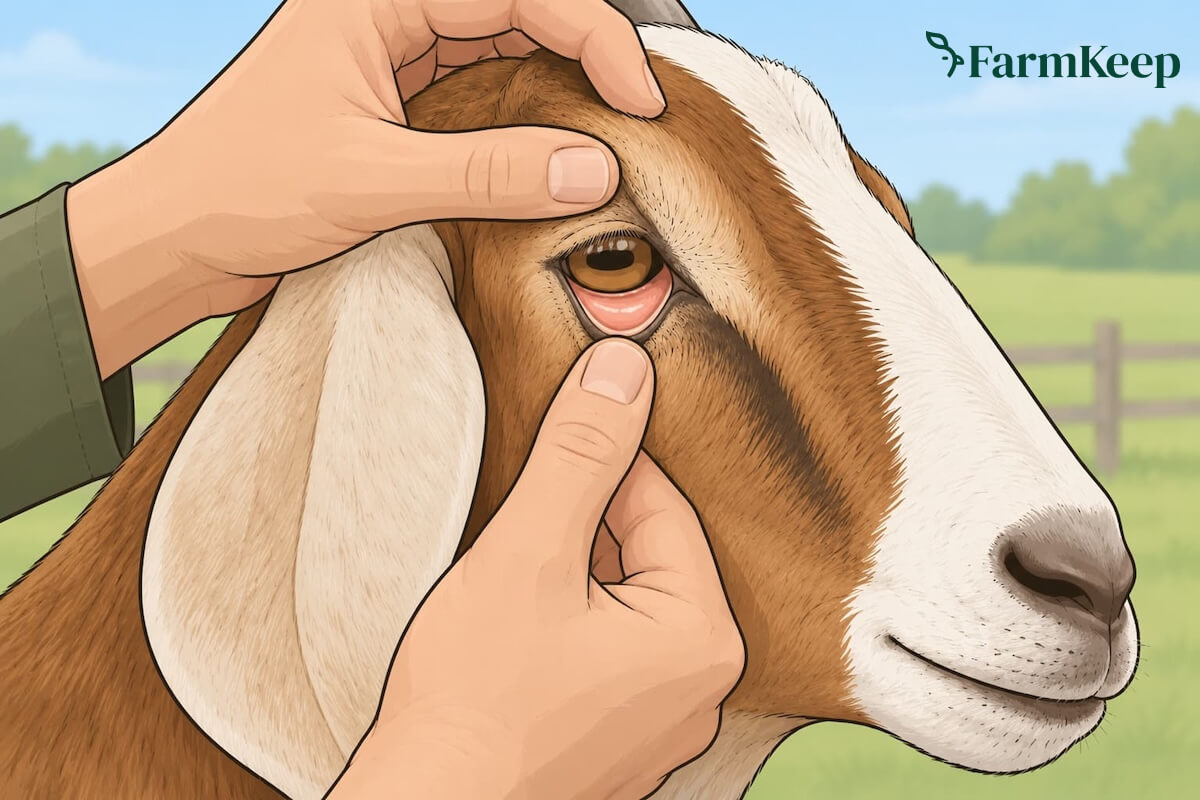
How to Check a Goat or Sheep With FAMACHA
You may hear FAMACHA described informally as “checking a goat’s eyes for worms.” That’s a useful shorthand, but it isn’t quite what the test does. You are checking the lower-eyelid mucous membrane for evidence of anemia—not looking for worms.
The general process is:
- Safely restrain the animal.
- Close the upper eyelid and use the proper FAMACHA technique to expose the conjunctiva inside the lower eyelid.
- Make sure you are evaluating the correct tissue rather than the third eyelid.
- Hold the official FAMACHA card close to the exposed conjunctiva.
- Compare the color directly with the official scoring categories.
- Assign and record the score.
Proper technique is important because simply pulling down the lower eyelid may not expose the tissue correctly. The third eyelid can also become visible during the examination. This tissue should not be scored because it is naturally paler and can result in an inaccurate assessment. FAMACHA training provides hands-on or instructional guidance for performing the examination correctly.
Can FAMACHA Tell if a Goat Has Worms?
Not by itself. This is one of the most important limitations of the system. FAMACHA measures anemia. It is particularly useful for barber pole worm because Haemonchus contortus feeds on blood. Other gastrointestinal parasites can cause problems without producing significant anemia. That means a goat can have a favorable FAMACHA score and still have internal parasites.
The opposite is also true. A pale eyelid does not automatically prove that barber pole worms are responsible. Other diseases and health problems can cause anemia.
A useful way to think about the test is:
FAMACHA asks: “How anemic does this animal appear to be?”
It does not answer: “What parasites does this animal have?”
Fecal testing, clinical observations and veterinary assessment can provide additional information when the cause of an animal’s condition is uncertain.
FAMACHA and Barber Pole Worm
FAMACHA is so closely associated with barber pole worm because of the way this particular parasite affects its host. Barber pole worms feed on blood inside the abomasum.
The progression can look like this:
Barber pole worms feed on blood
↓
The animal experiences blood loss
↓
Anemia develops
↓
Lower-eyelid mucous membranes become paler
↓
FAMACHA helps assess the degree of anemia
Animals with significant barber pole worm infections may also become weak, lose condition or develop swelling beneath the jaw known as bottle jaw. Severe infections can become life-threatening.
Related guide: Barber Pole Worm in Goats: Symptoms, Testing & Treatment
Related guide: Bottle Jaw in Goats: Causes, Symptoms & What to Do
Should You Deworm Based on a FAMACHA Score?
FAMACHA was designed to support targeted selective treatment, but deworming decisions should not be reduced to a universal rule based on a single number.
A producer may need to consider factors such as:
- FAMACHA score
- Age
- Pregnancy or lactation
- Body condition
- Bottle jaw
- Weight loss or poor growth
- Other signs of illness
- Nutrition
- Previous parasite problems
- Current parasite pressure
- Veterinary recommendations
Animals that are young, lactating, in poor body condition or otherwise vulnerable may require different management from a healthy mature animal with the same intermediate score. This is one reason proper FAMACHA training is important: the system isn’t simply a color chart that tells you which drug to administer. Animals that are severely anemic, extremely weak, having difficulty standing or rapidly deteriorating should receive prompt veterinary attention.
Related guide: Choosing the Best Dewormer for Goats
Why FAMACHA Can Help Slow Dewormer Resistance
Historically, parasite control often involved deworming every animal on a regular schedule. That approach creates strong selection pressure for drug-resistant parasites. When a herd or flock is treated, susceptible worms are more likely to die while parasites capable of surviving the treatment remain and reproduce. FAMACHA can help producers identify animals that actually need treatment while leaving others untreated.
The parasites carried by untreated animals remain in refugia, meaning they have not been exposed to the dewormer. Maintaining susceptible parasites in the population helps dilute resistant genetics and can slow the development of resistance. This is one reason modern parasite-control programs increasingly emphasize targeted treatment rather than automatic whole-herd deworming.
How Often Should You Check FAMACHA Scores?
There isn’t one monitoring schedule appropriate for every farm. How frequently animals need to be checked depends on factors such as:
- Season
- Temperature and rainfall
- Local parasite pressure
- Pasture conditions
- Previous parasite problems
- Age and physiological status
- Individual susceptibility
During periods of high barber pole worm risk, some parasite-management programs recommend checking animals as frequently as weekly or every couple of weeks. During lower-risk periods, monitoring may be less frequent. The important principle is that monitoring frequency should increase when parasite risk increases. This is also why recording the date of each check matters. Without records, it becomes surprisingly difficult to remember whether an animal was checked last week or six weeks ago.
Related guide: How to Check Your Goats for Worms
FAMACHA vs. Fecal Egg Counts
FAMACHA and fecal egg counts are sometimes discussed as though they are alternative ways of measuring the same thing. They aren’t. They answer different questions.
A FAMACHA score tells you something about the animal’s anemia at that moment. A quantitative fecal egg count provides information about parasite egg shedding at that moment. Neither provides a complete picture of an animal’s parasite status by itself.
Related guide: Goat Fecal Testing & Fecal Egg Counts
Look Beyond the FAMACHA Score
Parasite monitoring shouldn’t stop at the eyelid. The Five Point Check© is another small-ruminant parasite-management approach that considers several areas of the animal for signs associated with different parasite problems.
These observations include the:
- Eye — anemia
- Jaw — bottle jaw
- Back — body condition
- Rear — fecal soiling or scouring
- Nose or coat — depending on species and the parasite risks being assessed
The Five Point Check reinforces an important principle: Don’t manage an animal’s parasite health based on one number alone.
A sheep or goat with a favorable FAMACHA score should not automatically be considered parasite-free if it is losing weight, scouring, developing poor body condition or showing other signs of illness.
Using FAMACHA in Goats vs. Sheep
The same basic FAMACHA system is used with both sheep and goats, but producers should not assume the two species will always look identical.
One notable difference is that healthy goats are less likely than sheep to show the deepest red associated with a score of 1. This can make experience and proper training especially useful when learning to score goats.
Goats can also be particularly challenging when it comes to parasite control and dewormer resistance, making targeted monitoring valuable.
Whether you’re raising sheep or goats, the larger principle remains the same: FAMACHA should be used as part of an integrated parasite-management program rather than as a standalone diagnosis.
Why Tracking FAMACHA Scores Matters
One FAMACHA score gives you a snapshot. A series of scores gives you a history. Knowing that an animal scores a 3 today is useful. Knowing that the same animal was a 1 earlier in the season, moved to a 2, and is now a 3 tells you considerably more.
Records can help you identify:
- Animals whose scores are gradually worsening
- Animals that repeatedly become anemic
- Animals that frequently require treatment
- Changes following treatment
- Relationships between FAMACHA scores and fecal results
- Animals that maintain favorable scores under parasite challenge
- When each animal was last checked
Repeated records may also reveal meaningful differences between individual animals.
Some sheep and goats repeatedly struggle with barber pole worm while others remain comparatively healthy under similar conditions. Over time, those patterns can inform management, culling and breeding decisions.
Keep FAMACHA Records for Your Herd or Flock
A useful FAMACHA record can be very simple. At minimum, record:
- Animal name or ID
- Species
- Date
- FAMACHA score
For more complete parasite records, you may also want to track:
- Bottle jaw
- Body condition
- Weight
- Fecal test results
- Eggs per gram (EPG)
- Treatments
- Follow-up dates
- Notes
For example:
This example illustrates record keeping only and is not a treatment protocol. This is where individual livestock records become especially useful.
FAQ
What is a FAMACHA score?
A FAMACHA score is an assessment of anemia based on the color of the mucous membrane inside the lower eyelid of a sheep or goat. The system uses scores from 1 through 5, ranging from a non-anemic appearance to severe anemia.
What do FAMACHA scores 1–5 mean?
Scores 1 and 2 represent non-anemic categories, score 3 is intermediate, score 4 indicates anemia and score 5 indicates severe anemia. Actual scoring should be performed using proper FAMACHA technique and an official score card.
What is a FAMACHA card for goats?
The same FAMACHA system is used for goats and sheep. The official card contains five standardized color categories that are compared with the conjunctiva inside the lower eyelid to assess anemia.
Can I print a FAMACHA score card?
A card printed from an online image should not be used in place of the official FAMACHA card. Printer, screen and image color differences can alter the colors and potentially result in inaccurate scoring. The official cards are also copyrighted.
Where can I buy a FAMACHA card?
Official FAMACHA cards are generally obtained in association with approved FAMACHA training. In the United States, consult the American Consortium for Small Ruminant Parasite Control for current information about FAMACHA training and certification.
Does a pale eyelid mean a goat or sheep has worms?
Not necessarily. Barber pole worm can cause anemia and pale mucous membranes, but anemia can have other causes. A pale eyelid should therefore be considered alongside the animal’s other clinical signs and health information.
Can FAMACHA diagnose barber pole worms?
No. FAMACHA assesses anemia rather than directly detecting barber pole worms. Because barber pole worm is a blood-feeding parasite, FAMACHA is particularly useful when Haemonchus contortus is an important parasite in the herd or flock.
Is FAMACHA the same as a fecal test?
No. FAMACHA evaluates anemia. A quantitative fecal egg count estimates parasite egg shedding and reports results as eggs per gram. The two tools provide different information and can complement each other.
How often should you FAMACHA goats and sheep?
There is no universal schedule appropriate for every farm. Monitoring should reflect parasite risk, season, climate, pasture conditions and individual animal susceptibility. During high-risk barber pole worm periods, monitoring may need to occur much more frequently than during low-risk periods.
Should you deworm based only on FAMACHA?
FAMACHA was developed to support targeted selective treatment, but treatment decisions should consider the animal’s overall condition and other risk factors. Producers should receive proper FAMACHA training and work with their veterinarian to develop an appropriate parasite-control program.
Sources & Further Reading
The following small-ruminant parasite-management resources were referenced in preparing this guide:
- American Consortium for Small Ruminant Parasite Control — FAMACHA© Resources
- WormBoss — FAMACHA
- National Center for Appropriate Technology (NCAT/ATTRA) — Why FAMACHA© Score?
- National Center for Appropriate Technology (NCAT/ATTRA) — Managing Internal Parasites in Sheep and Goats
- National Center for Appropriate Technology (NCAT/ATTRA) — Tools for Managing Internal Parasites in Small Ruminants: Animal Selection