This article is intended for educational purposes and is not a substitute for veterinary diagnosis or treatment. Work with your veterinarian when diagnosing or treating parasite problems in goats.
How to Check Goats for Worms
If you suspect a goat has worms, there isn’t one symptom or quick check that can give you a definitive answer. Internal parasites affect goats in different ways, so a good parasite check means looking at the whole animal: eyelid color, swelling under the jaw, body condition, weight, manure, appetite, energy and overall performance.
Fecal testing can provide additional information about the parasite eggs a goat is shedding, but it also doesn’t tell the whole story on its own. The goal isn’t to find one universal “sign of worms.” It’s to look for multiple signs that something may be wrong and determine whether the goat needs closer evaluation, testing or treatment.

Can You Tell if a Goat Has Worms Just by Looking at It?
Sometimes parasites cause obvious clinical signs. Other times, the changes are much more subtle. Possible signs of an internal parasite problem include:
- Pale lower eyelids
- Swelling under the jaw
- Weight loss
- Poor body condition
- Poor growth
- Diarrhea or fecal soiling
- Weakness or lethargy
- Reduced appetite
- Declining performance or production
However, these signs aren’t specific to parasites. Other illnesses can produce similar symptoms, and different parasites affect goats differently. For example, barber pole worm (Haemonchus contortus) feeds on blood and can cause severe anemia. A goat with a heavy barber pole infection may have very pale eyelids and become weak without ever developing diarrhea. That’s why checking a goat for worms should involve several observations rather than relying on a single symptom.
Steps To Check for Worms in Goats
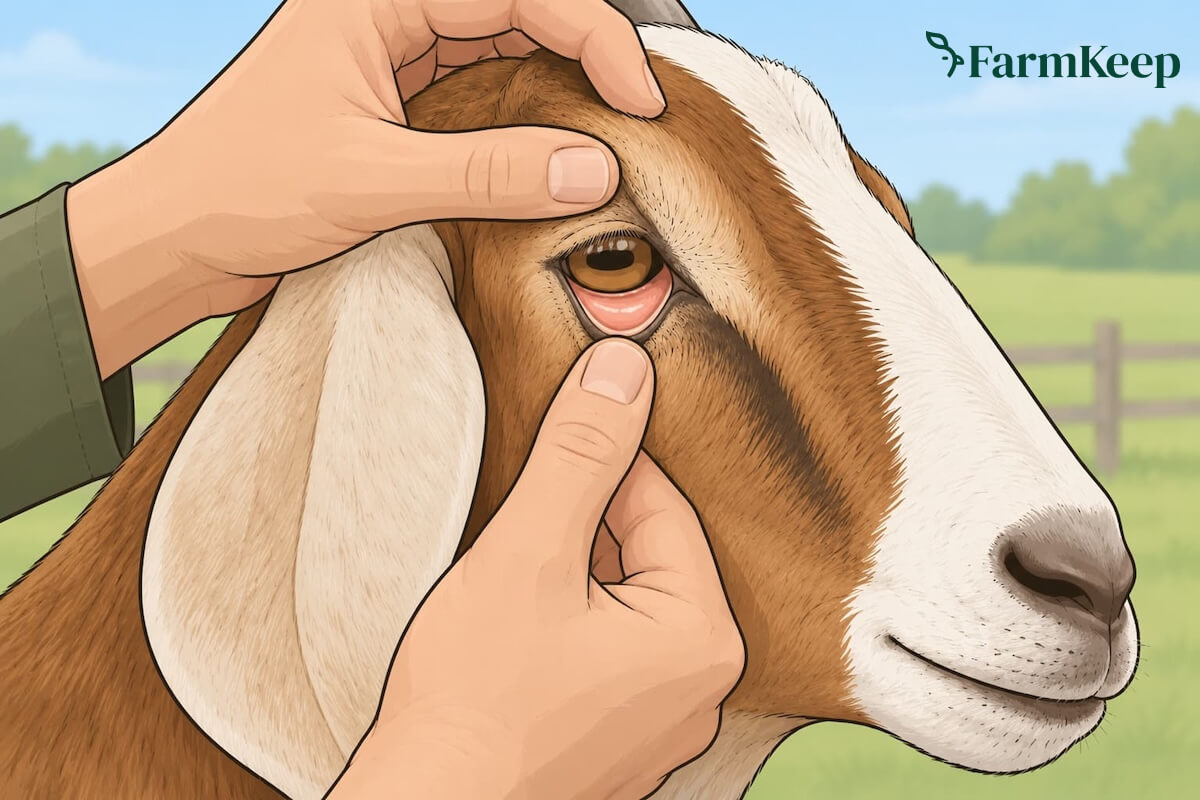
1. Check the Lower Eyelids for Signs of Anemia
Examining the lower eyelid is one of the most useful checks when barber pole worm is a concern.
You may hear goat owners refer to this as “checking a goat’s eyes for worms,” but you’re not actually looking for worms in the eye. You’re looking for signs of anemia.
Barber pole worms live in the goat’s abomasum and feed on blood. Heavy infections can result in substantial blood loss and potentially severe anemia. As anemia becomes more pronounced, the mucous membranes inside the lower eyelid may become increasingly pale.
FAMACHA© is the standardized system used to evaluate lower-eyelid color for anemia in sheep and goats. It can be an important part of targeted parasite management when barber pole worm is a concern.
However, FAMACHA doesn’t diagnose worms. It evaluates anemia. Other medical conditions can also cause anemia, and many parasites don’t cause anemia at all.
For detailed instructions on the scoring system, proper technique, score interpretation and official FAMACHA cards, see:
Related guide: FAMACHA Score: How to Use FAMACHA for Goats & Sheep
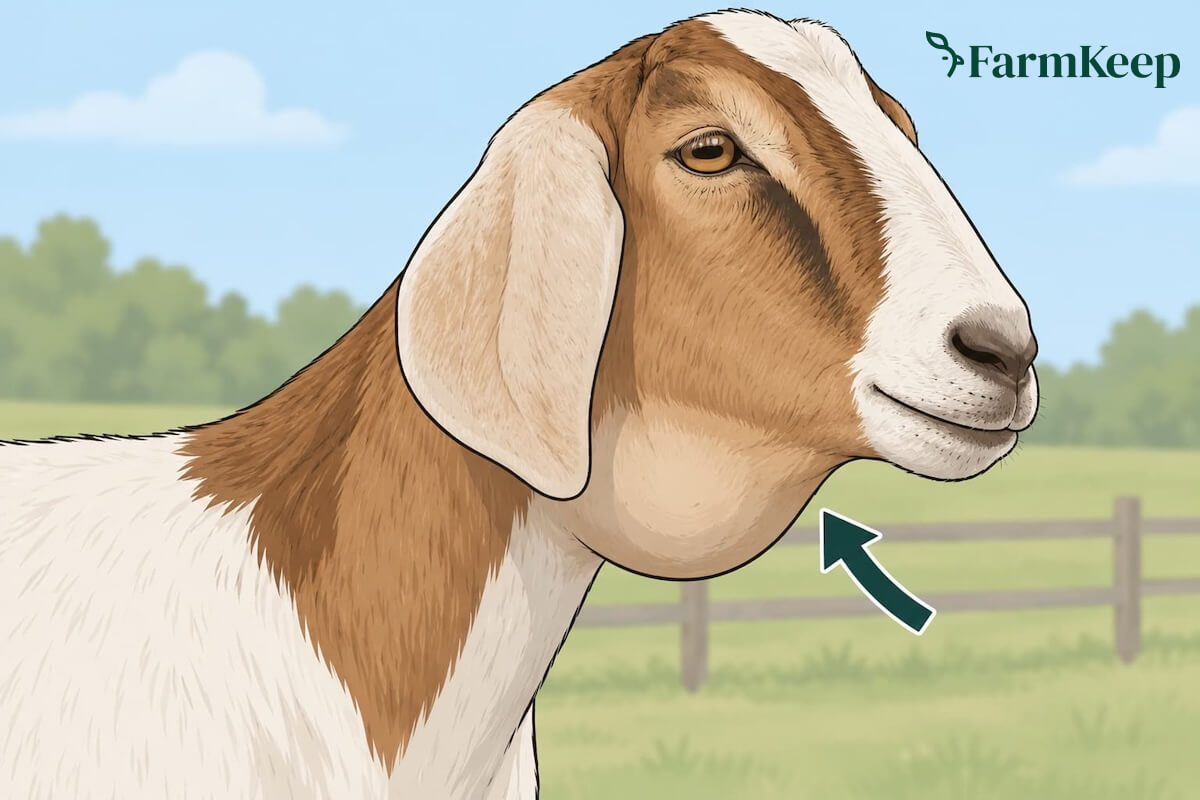
2. Check Under the Jaw for Bottle Jaw
Next, look and feel underneath the goat’s lower jaw. Soft, fluid-filled swelling in this area is commonly called bottle jaw, or submandibular edema. Bottle jaw is often associated with significant gastrointestinal parasitism, particularly severe barber pole worm infections. Because barber pole worms feed on blood, a heavy infection can result in blood and protein loss. Low blood protein can contribute to fluid accumulating in the tissues beneath the jaw.
Bottle jaw should be taken seriously, especially when it appears alongside pale mucous membranes, weakness or declining body condition. However, bottle jaw isn’t itself a diagnosis of worms. Other health problems can also cause edema or swelling beneath the jaw. For a deeper explanation of what causes this swelling and what to do when you find it, see: Bottle Jaw in Goats: Causes, Symptoms & What to Do

3. Check Body Condition and Weight
Parasite problems don’t always produce a dramatic physical symptom. Sometimes the first indication is simply that a goat isn’t maintaining condition as expected.
Look for:
- Unexplained weight loss
- Declining body condition
- Poor growth in young goats
- Reduced performance or production
- A rough or poor-quality hair coat
Don’t judge a goat’s body condition solely by looking at its abdomen. A full rumen can make a goat appear substantial from the side even when the animal is losing condition elsewhere. Hands-on body condition assessment is more useful. Regular weights can also help identify gradual changes that are difficult to see from one day to the next. The trend is often more informative than the individual number. A goat that has slowly lost weight or body condition over several weeks deserves closer attention, particularly if you also find other signs associated with parasites.
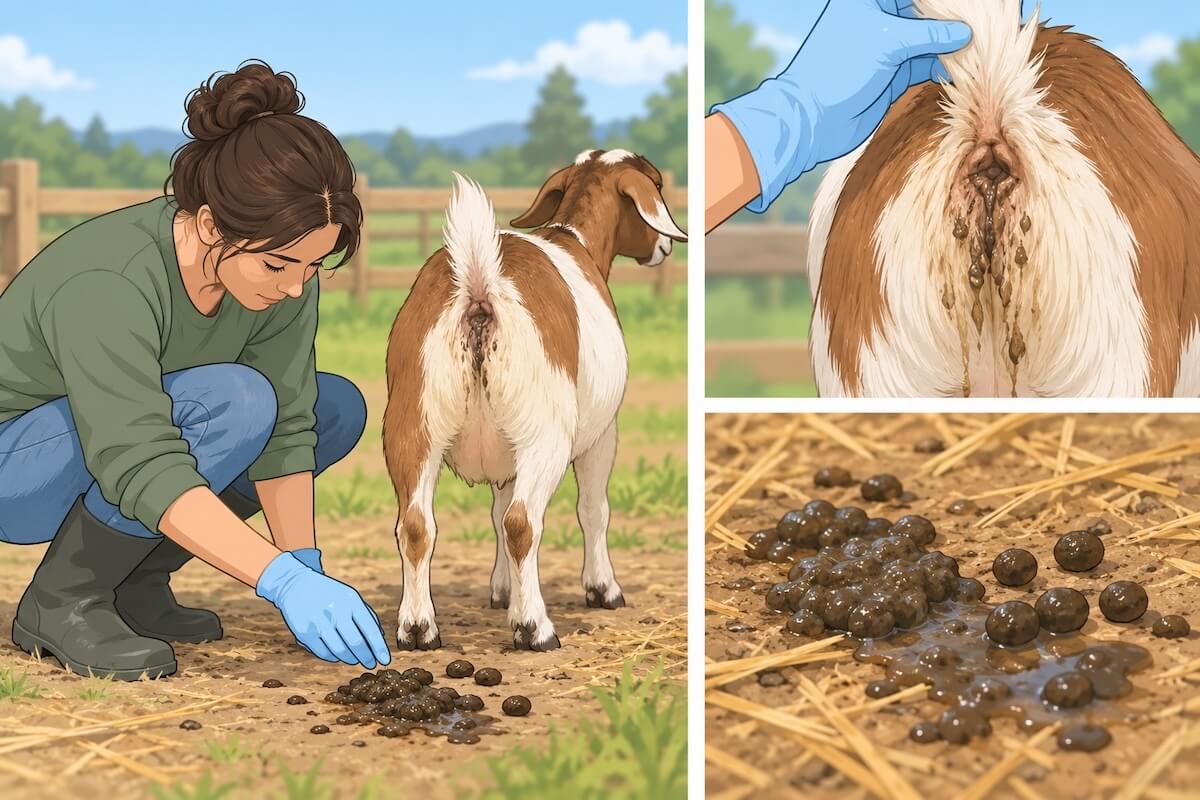
4. Look at Manure and the Tail Area
Check the goat’s manure and the area beneath its tail.
Some gastrointestinal parasites can contribute to:
- Loose manure
- Diarrhea
- Fecal soiling
- Poor growth
- Weight loss
- Poor body condition
Young goats with diarrhea may also be affected by coccidiosis. Coccidia are internal parasites, but they are protozoa rather than worms and are particularly important in kids. At the same time, normal goat pellets do not rule out worms. This is especially important with barber pole worm. Diarrhea is not characteristic of a pure Haemonchus infection, so a goat can have a serious barber pole worm problem while continuing to produce formed feces. Manure is therefore one useful part of the check—not a standalone parasite test.
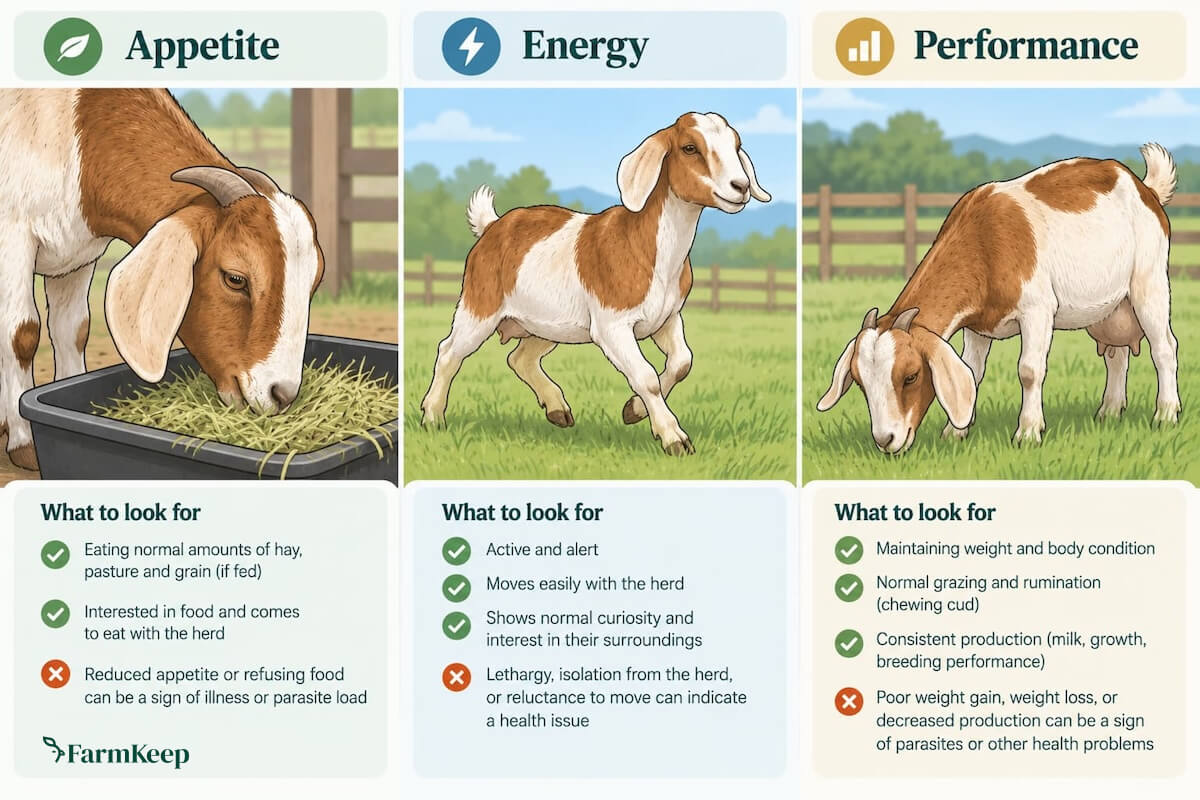
5. Watch Appetite, Energy and Performance
Think about how the goat is behaving compared with what’s normal for that individual.
Is the goat:
- Eating normally?
- Alert and responsive?
- Keeping up with the rest of the herd?
- Maintaining weight?
- Growing normally?
- Producing as expected?
- Spending more time lying down or separated from the herd?
Heavy parasite burdens can affect a goat’s overall performance before the animal appears critically ill. A goat that seems slightly “off” may not necessarily have parasites, but changes in appetite, energy or performance become more meaningful when they occur alongside pale eyelids, weight loss, bottle jaw, diarrhea or other signs.
6. Put the Signs Together
One of the most important principles of parasite monitoring is to avoid making a decision based on one observation. The Five Point Check© provides a useful framework for looking at several areas of a sheep or goat rather than relying on a single sign.
The purpose isn’t to diagnose every parasite through a physical examination. Instead, looking at multiple indicators helps you identify animals that may need closer evaluation. A goat with normal body condition, normal behavior and no clinical signs presents a different picture from a goat with pale eyelids, bottle jaw, weight loss and weakness. Look at the goat as a whole.
7. Consider a Fecal Test
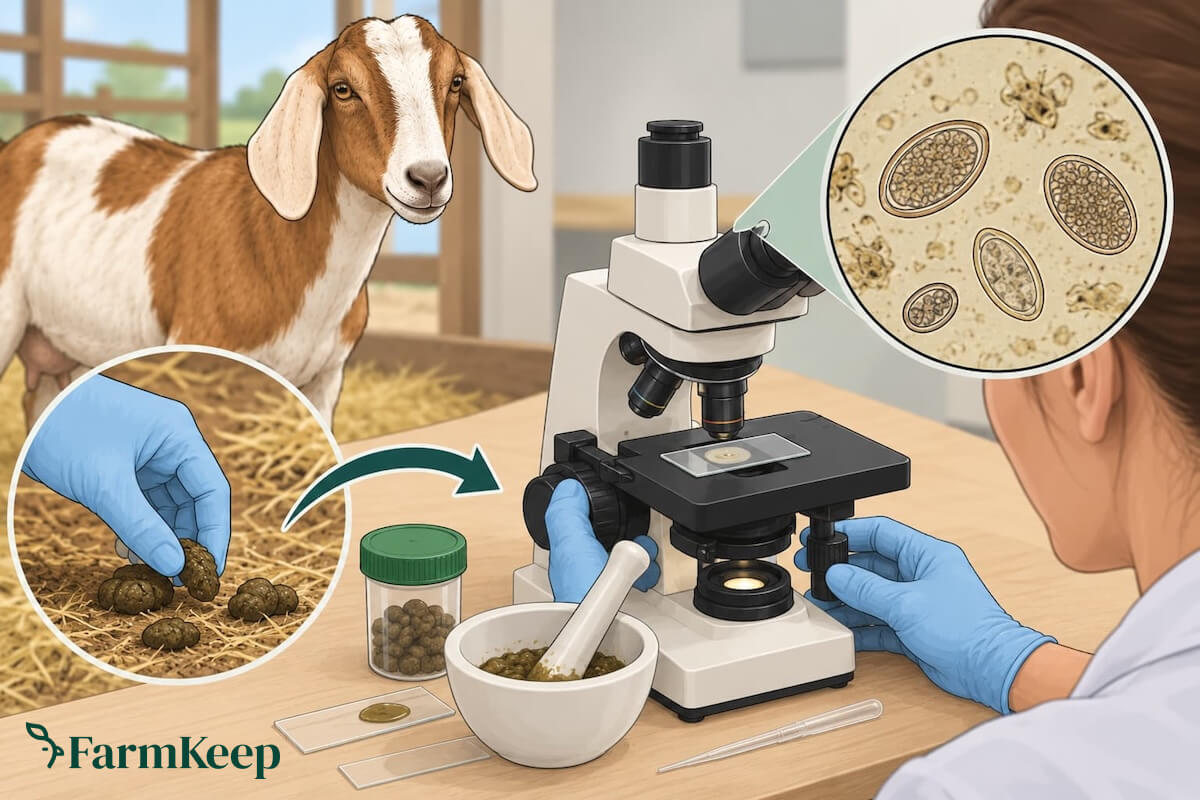
Physical checks tell you what’s happening with the goat. Fecal testing can provide additional information about the parasites the goat is shedding. A fecal examination looks for parasite eggs or oocysts in manure. A quantitative fecal egg count (FEC) goes a step further by estimating the number of parasite eggs being shed. Results are commonly reported as: EPG = eggs per gram of feces.
Fecal egg counts can help identify parasite patterns and animals that repeatedly shed large numbers of eggs. But an EPG result isn’t a direct count of the number of worms living inside the goat, and there isn’t one universal EPG number at which every goat should automatically be treated. Fecal testing also has other limitations. Some gastrointestinal worms produce similar-looking eggs, while immature parasites may be present before they begin producing detectable eggs.
For information about collecting samples, understanding EPG, interpreting results and using fecal testing over time, see: Goat Fecal Testing & Fecal Egg Counts
Physical Checks, FAMACHA and Fecal Testing: What’s the Difference?
These methods aren’t competing tests. They provide different pieces of information.
No single method answers every parasite-management question. Using multiple observations—and keeping track of how they change over time—provides much more useful information than relying on one symptom or test result.
Keep a Parasite Check History for Every Goat
When you check a goat for worms, record what you find.Over time, these records can help answer questions that are difficult to reconstruct from memory:
- Does this goat repeatedly become anemic?
- Has its body condition been declining?
- Does it consistently have higher fecal egg counts?
- How frequently has it required treatment?
- Did it improve after the last treatment?
If you want to move to digital records, FarmKeep lets you easily keep parasite observations, fecal results, treatments and follow-ups with each goat’s health history so you can see changes and recurring patterns over time.
What Should You Do if You Find Signs of Worms?
Finding one possible sign of parasites doesn’t necessarily mean you should immediately deworm the goat. Instead, consider the complete picture.
That might include:
- Physical signs
- FAMACHA where appropriate
- Body condition and weight
- Fecal testing
- Previous parasite problems
- Previous treatments
- The goat’s age and condition
- Current parasite risk
- Veterinary evaluation
Current small-ruminant parasite-management recommendations favor targeted selective treatment rather than automatically deworming every goat on a calendar. This is important because dewormer resistance is widespread. Repeatedly treating animals unnecessarily increases selection pressure for resistant parasites. If treatment is needed, work with your veterinarian on an appropriate parasite-control plan, particularly if a goat is ill, the diagnosis is uncertain or you don’t know which dewormers remain effective on your farm.
Read the Goat Dewormer Guide: How to Choose & Use Dewormers For Your Goats
Know What’s Normal for Each Goat
One of the easiest ways to spot a developing health problem is to know what is normal for the individual animal.
Over time, it helps to know each goat’s typical:
- Weight
- Body condition
- FAMACHA history
- Manure
- Appetite
- Behavior
- Growth or production
- Previous parasite problems
Individual goats can differ considerably in how they respond to parasite exposure. Some repeatedly struggle with parasites, while others maintain good condition under similar circumstances. This is why a parasite check becomes much more useful when it’s part of an animal’s health history rather than an isolated observation. Instead of asking only: “Does this goat look like it has worms today?”, you can begin asking: “Is something changing with this goat?”
When to Call a Veterinarian
Parasite infections can become serious quickly, particularly when a goat is severely anemic or dehydrated.
Seek prompt veterinary care if a goat shows signs such as:
- Very pale or white mucous membranes
- Severe weakness or lethargy
- Difficulty standing
- Collapse
- Significant bottle jaw accompanied by illness
- Severe or persistent diarrhea
- Dehydration
- Rapid weight loss
- Rapid deterioration
- Failure to improve following treatment
Veterinary guidance is also important when you’re unsure what’s causing the symptoms or when parasite problems continue despite treatment.
FAQ
How can I tell if my goat has worms?
There isn’t one symptom that confirms worms. Check the goat’s eyelids, jaw, body condition, weight, manure, appetite, energy and overall health. Fecal testing can provide additional information about parasite eggs being shed.
How do you check a goat’s eyes for worms?
When people talk about checking a goat’s eyes for worms, they’re usually referring to examining the lower-eyelid mucous membranes for signs of anemia. FAMACHA provides a standardized method for assessing anemia in sheep and goats, particularly when barber pole worm is a concern.
For information about FAMACHA scores and proper scoring technique, see FAMACHA Score: How to Use FAMACHA for Goats & Sheep.
Do pale eyelids mean a goat has worms?
Not necessarily. Pale eyelids can indicate anemia, and barber pole worm is an important cause of anemia in goats. Other health conditions can also cause anemia, so pale eyelids alone don’t diagnose worms.
Can a goat have worms with normal poop?
Yes. Barber pole worm can cause significant anemia without causing diarrhea, so normal goat pellets don’t rule out an internal parasite problem.
Does diarrhea mean a goat has worms?
Not necessarily. Some gastrointestinal parasites can contribute to diarrhea, but diarrhea has many possible causes. Coccidiosis can also cause diarrhea, particularly in young goats, and coccidia are protozoan parasites rather than worms.
What is bottle jaw in goats?
Bottle jaw is soft swelling beneath the lower jaw caused by fluid accumulation. It is commonly associated with significant gastrointestinal parasitism, particularly severe barber pole worm infection, but it can have other causes.
Can you test goat poop for worms?
Yes. Fecal examinations can detect parasite eggs or oocysts in manure. Quantitative fecal egg counts can also estimate how many parasite eggs are being shed per gram of feces.
What does EPG mean in goats?
EPG means eggs per gram of feces. It is an estimate of parasite egg shedding, not a direct count of the number of worms living inside the goat.
Should I deworm a goat if I think it has worms?
Not automatically. Treatment decisions should consider the goat’s clinical condition, parasite risk, FAMACHA where appropriate, fecal findings, previous history and veterinary guidance. Routine calendar-based deworming can contribute to dewormer resistance.
How often should I check my goats for worms?
There isn’t one monitoring schedule appropriate for every herd. Parasite pressure varies with climate, season, pasture conditions, age, production stage and individual susceptibility. Monitoring should be adjusted to the parasite risk in your herd, with higher-risk animals and higher-risk periods receiving closer attention.
Sources & Further Reading
The following veterinary, university Extension and small-ruminant parasite-control resources were referenced in preparing this guide:
- American Consortium for Small Ruminant Parasite Control — FAMACHA©
- American Consortium for Small Ruminant Parasite Control — Five Point Check©
- American Consortium for Small Ruminant Parasite Control — Fecal Egg Counting
- University of Minnesota Extension — Managing Barberpole Worms in Sheep and Goats
- University of Maryland Extension — When Should I Deworm My Sheep/Goats?
- MSD Veterinary Manual — Common Gastrointestinal Parasites of Small Ruminants