This article is intended for educational purposes and is not a substitute for veterinary diagnosis or treatment. Work with your veterinarian or diagnostic laboratory when interpreting fecal results or making treatment decisions.
Goat Fecal Testing & Fecal Egg Counts: A Practical Guide
Fecal testing is one of the most useful tools available for understanding gastrointestinal parasites in goats. By examining a manure sample for parasite eggs or oocysts, a fecal examination can provide information about the parasites an animal is shedding and help guide a broader parasite-management program.
A quantitative fecal egg count (FEC) goes a step further by estimating the number of parasite eggs present per gram of manure. Results are commonly reported as EPG, or eggs per gram.
But an EPG number isn’t a simple “worm score.” A fecal egg count does not directly count the worms living inside your goat, and there isn’t one universal EPG number at which every goat should automatically be dewormed.
Understanding what fecal testing can—and cannot—tell you makes the results much more useful.
What Is a Goat Fecal Test?
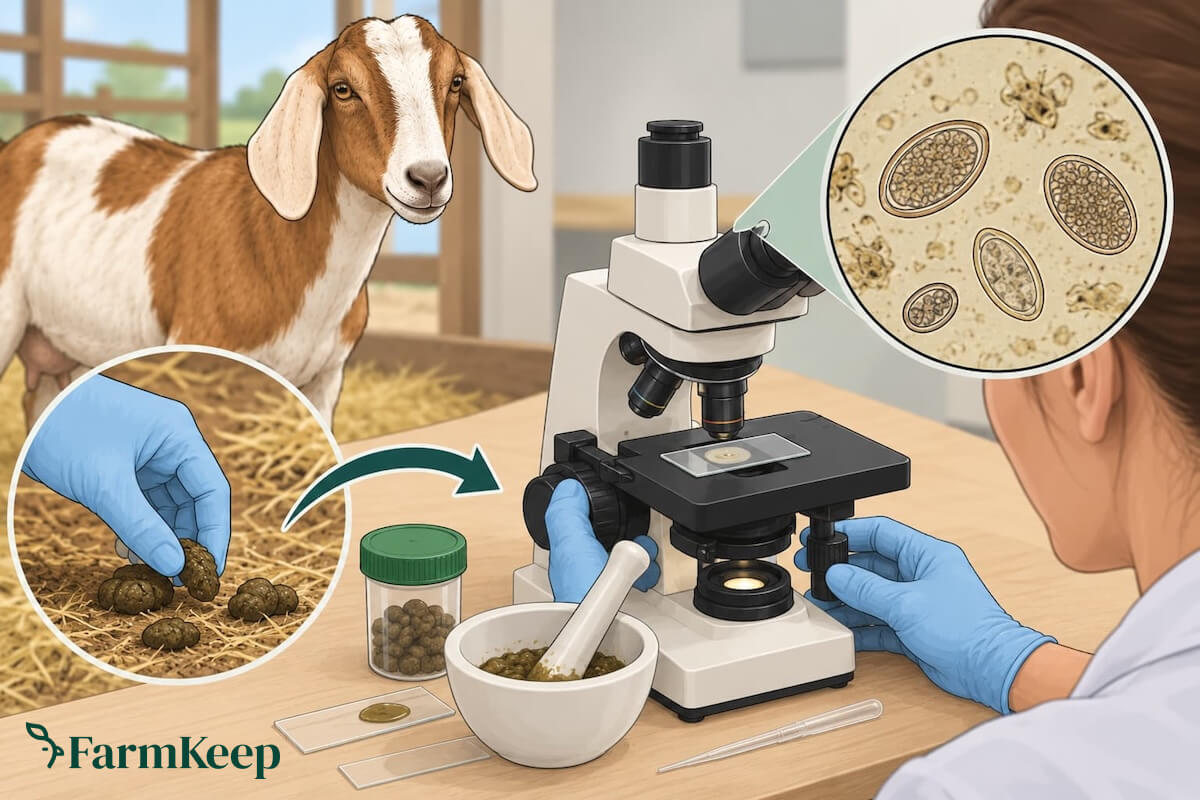
A goat fecal test examines a manure sample for evidence of internal parasites. Veterinarians, diagnostic laboratories and trained producers may use several types of fecal examination. One of the most common is fecal flotation, which uses a flotation solution to separate parasite eggs and oocysts from the fecal material so they can be examined under a microscope.
Some fecal examinations are primarily qualitative: they determine whether particular types of parasite eggs or oocysts are present. A quantitative fecal egg count, on the other hand, estimates how many eggs are being shed.
The result is usually expressed as: EPG = eggs per gram of feces
Techniques such as the McMaster method can be used to calculate quantitative fecal egg counts. The important distinction is that a fecal egg count measures egg shedding, not the exact number of adult worms living inside the goat.
What Does a Goat Fecal Test Look For?
Fecal examinations can detect evidence of several internal parasites, depending on the testing method being used. A laboratory report may include findings such as:
- Strongyle-type eggs
- Coccidia oocysts
- Other parasite eggs or oocysts detected in the sample
One limitation is that the eggs of several gastrointestinal nematodes can look very similar under routine microscopic examination.
For example, barber pole worm (Haemonchus contortus) belongs to a group of gastrointestinal nematodes whose eggs may be reported as strongyle-type eggs on a routine fecal examination. Standard egg morphology generally cannot tell you exactly which strongyle species produced each egg. That means a fecal result showing strongyle-type eggs should not automatically be interpreted as a specific number of barber pole worms. Additional diagnostic methods may be needed when identifying the particular parasite species is important.
What Is a Fecal Egg Count?
A fecal egg count estimates the number of parasite eggs present in a measured amount of manure. The result is typically expressed as eggs per gram, abbreviated EPG. For example, if a quantitative fecal test reports: "Strongyle-type eggs: 800 EPG" , the test is estimating the number of strongyle-type eggs being shed per gram of feces. It does not mean the goat has 800 worms.
That distinction is important because adult parasites vary in how many eggs they produce, and egg production can change based on parasite species and other biological factors. Fecal egg counts are therefore best understood as a measure of parasite egg shedding rather than a direct census of the parasites living inside an animal.
Does a Higher EPG Mean a Goat Has More Worms?
A higher fecal egg count can indicate greater parasite egg shedding, but the relationship between EPG and the actual number of worms inside a goat is not a simple one-to-one calculation. Several factors can affect fecal egg count results.
Different parasite species produce different quantities of eggs. Egg production can also vary between individual worms and at different stages of infection. Timing matters as well. Young parasites can be present inside an animal before they mature and begin producing eggs. During this prepatent period, a goat may be infected even though the immature parasites are not yet contributing eggs to a fecal count.
For these reasons, higher EPG means more eggs being shed. Higher EPG does not mean that exact proportion of additional adult worms. Fecal egg counts provide useful information, but they should be interpreted in context.
What Is a High Fecal Egg Count in Goats?
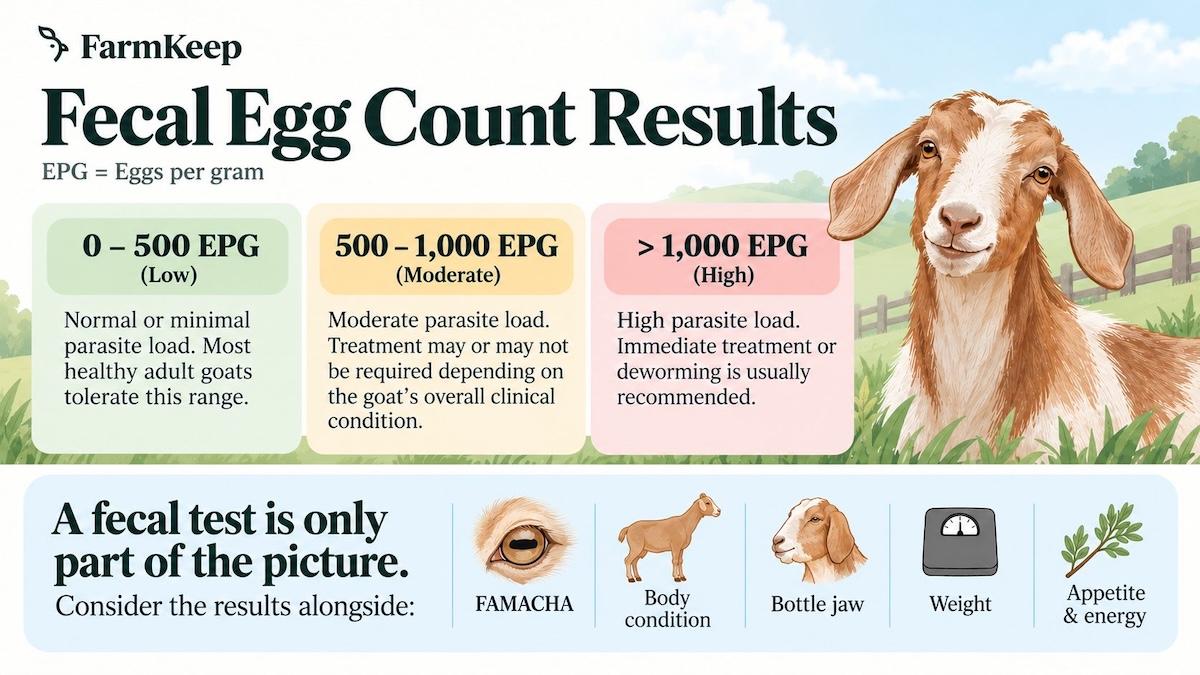
One of the first questions many goat owners have after receiving fecal results is whether their goat’s EPG is “high.” Unfortunately, there isn’t one number that provides a universal answer. There is no single EPG threshold at which every goat should automatically be dewormed.
The significance of a fecal egg count depends on factors including:
- The parasite or parasite group involved
- The goat’s clinical condition
- FAMACHA score
- Body condition
- Age
- Physiological status
- Previous parasite problems
- Individual susceptibility
- Herd history
- Environmental parasite pressure
Fecal egg counts are particularly useful when interpreted alongside information about the animal rather than treated as an isolated laboratory number. For example, the same numerical result may have different significance in a healthy adult goat maintaining good body condition versus a young or otherwise vulnerable animal showing signs of parasitism. A veterinarian or veterinary diagnostic laboratory can help interpret fecal results in the context of your animals and herd.
How Do You Collect a Fecal Sample From a Goat?
Good fecal testing starts with a good sample. If you are submitting samples to a veterinarian or laboratory, follow their specific collection and handling instructions. Requirements may vary depending on the test being performed. For a typical parasite fecal examination, the process generally looks like this:

1. Identify the Goat
If you’re testing individual animals, make sure each sample stays associated with the correct goat. Label the container or bag with information such as:
- Goat name or identification number
- Collection date
- Other information requested by the veterinarian or laboratory
Individual identification is especially important if you want to compare fecal results with FAMACHA scores, symptoms, previous treatments or future test results.
2. Collect a Fresh Sample
Use freshly passed fecal pellets whenever possible. A sample may be collected directly from the animal or from freshly passed manure before it becomes contaminated with soil, bedding or manure from another animal.
3. Place the Sample in a Clean Container
Place the sample in an appropriate clean, leak-proof container or bag. Avoid mixing samples from different animals unless you have specifically been instructed to submit a pooled sample.
4. Store the Sample Properly
If the sample cannot be examined immediately, follow your veterinarian or laboratory’s instructions for storage. Samples are generally kept cool rather than left in heat or direct sunlight, but specific handling requirements can depend on the diagnostic test.
5. Submit the Sample Promptly
Fecal samples should be examined as promptly as practical. Ask the laboratory or veterinarian performing the test how they would like samples collected, stored and transported. You can also conduct a fecal exam at home by purchasing an at home fecal exam kit and following the instructions in the kit.
How Are Goat Fecal Egg Counts Performed?
The exact laboratory procedure varies depending on the method being used, but quantitative fecal egg counting generally follows the same basic concept.
- A measured fecal sample is collected
- The feces are mixed with a flotation solution
- Parasite eggs are separated from fecal debris
- The prepared sample is examined under a microscope
- Eggs are identified and counted
- The count is converted into eggs per gram (EPG)
The McMaster technique is one commonly used method for performing quantitative fecal egg counts. With McMaster testing, a known amount of feces and flotation solution is used with a specialized counting chamber. Eggs observed within designated areas of the chamber are counted and used to calculate an estimated EPG.
Different fecal egg counting techniques can have different detection limits and sensitivities, which is another reason results should be interpreted with some understanding of how the test was performed.
FAMACHA vs. Fecal Egg Counts: What’s the Difference?
FAMACHA and fecal egg counts are both valuable parasite-management tools, but they answer different questions.
A simple way to remember the difference is: FAMACHA tells you something about the goat. A fecal egg count tells you something about the parasite eggs the goat is shedding. Neither provides the complete picture by itself.
Related guide: FAMACHA Score for Goats: What It Means & How It’s Used
Fecal Egg Count Reduction Test (FECRT): Did the Dewormer Work?
Fecal egg counts aren’t only useful for monitoring parasite egg shedding. They can also help answer another important question: Is the dewormer you’re using still effective against the parasites on your farm? This is done with a fecal egg count reduction test (FECRT), which compares fecal egg counts before and after treatment.
Dewormer resistance is a significant problem in sheep and goats, and resistance can vary from one farm to another. A product that remains effective on one farm may perform poorly on another. Testing treatment effectiveness is therefore more reliable than assuming a particular dewormer is working simply because it has worked in the past.
How Does a Fecal Egg Count Reduction Test Work?
A standard fecal egg count provides a snapshot of parasite egg shedding at one point in time. An FECRT uses multiple fecal egg counts to measure how much egg shedding changes following treatment.
The basic process looks like this:
- Pre-treatment fecal egg count
- Deworming treatment
- Post-treatment fecal egg count
- Compare the results
For a formal herd-level FECRT, samples should be collected from the same animals before and after treatment. Current small-ruminant guidance generally recommends testing a group of animals rather than relying on one goat to determine whether resistance exists across the herd.
Timing also matters. Small-ruminant FECRT protocols commonly collect the follow-up sample approximately 10–14 days after treatment, although the appropriate testing protocol should be confirmed with your veterinarian, diagnostic laboratory or current parasite-control guidance.
How Do You Calculate Fecal Egg Count Reduction?
The percentage reduction can be calculated by comparing the pre-treatment and post-treatment eggs-per-gram (EPG) results: Fecal Egg Count Reduction (%) = [(Pre-treatment EPG − Post-treatment EPG) ÷ Pre-treatment EPG] × 100
For example, imagine a group of goats has an average pre-treatment fecal egg count of 2,000 EPG and an average post-treatment count of 200 EPG. The calculation would be: [(2,000 − 200) ÷ 2,000] × 100 = 90% reduction. This example demonstrates how the calculation works; it should not be interpreted as a universal threshold for acceptable dewormer effectiveness.
Formal FECRT interpretation depends on the testing protocol and methodology being used. Current small-ruminant resources use efficacy thresholds around 90–95%, with some guidance considering failure to achieve a 95% reduction evidence of resistance. Because sample size, starting egg counts, laboratory methods and other factors can affect the reliability of the result, suspected resistance is best interpreted with a veterinarian or experienced small-ruminant parasite professional.

What If the Fecal Egg Count Doesn’t Drop Enough?
A smaller-than-expected reduction in fecal egg counts can indicate that parasites on the farm have developed resistance to the dewormer being used. An important distinction is the goat doesn’t become resistant to the dewormer. The parasites do. Repeated exposure to dewormers creates selection pressure. Susceptible worms are more likely to be killed by treatment, while resistant worms survive and reproduce. Over time, resistant parasites can make up an increasingly large proportion of the parasite population on a farm.
However, an unexpected FECRT result doesn’t automatically prove drug resistance. Treatment administration, animal weight and dosing, sample timing, starting egg counts, sample collection and laboratory methodology can all affect the result. If a dewormer appears to be ineffective, work with your veterinarian before simply switching products or repeatedly treating the animal. Confirming what is happening can help you develop a parasite-control strategy based on the resistance patterns present on your farm rather than trial and error.
Why FECRT Records Matter
A fecal egg count reduction test creates a sequence of information that is much more useful when it stays connected: Animal → Pre-treatment FEC → Treatment → Follow-up FEC → Treatment effectiveness
Recording the animal ID, sample dates, EPG results, treatment date and treatment used makes it possible to look back at how animals responded and whether the same dewormer continues to perform effectively over time. This history can also help you have a more informed conversation with your veterinarian when treatment effectiveness or dewormer resistance becomes a concern.
FarmKeep lets you keep fecal test results, treatments, health observations and follow-up records together in each animal’s health history, making it easier to see how parasite management changes over time.
Can a Fecal Test Diagnose Barber Pole Worm?
A routine fecal egg count can provide useful information when managing barber pole worm, but it may not specifically identify Haemonchus contortus. Barber pole worm eggs are generally categorized with other strongyle-type eggs, many of which are difficult to distinguish from one another using routine microscopic egg identification.
More specialized testing may be needed to determine which strongyle species are present. That doesn’t make fecal egg counts unhelpful for barber pole worm management.
Instead, fecal results can be considered alongside:
- FAMACHA scores
- Pale mucous membranes
- Bottle jaw
- Body condition
- Weight and performance
- Other clinical signs
- Previous parasite problems
- Treatment history
A goat with signs of anemia, worsening FAMACHA scores and significant strongyle-type egg shedding, for example, provides more information to a veterinarian or producer than any one observation alone.
Related guide: Barber Pole Worm in Goats: Symptoms, Testing & Treatment
Related guide: Bottle Jaw in Goats: Causes, Symptoms & What to Do
When Should You Fecal Test Your Goats?
There isn’t one fecal testing schedule that is appropriate for every herd. Testing can be particularly useful in several situations.
When a Goat Shows Possible Signs of Parasites
Weight loss, declining body condition, poor growth, diarrhea, anemia, bottle jaw and reduced performance can all warrant further investigation.
Because different parasites produce different clinical signs, fecal testing can provide additional information alongside your observations of the animal.
When You Want to Understand Parasite Patterns in Your Herd
Periodic fecal testing can help identify patterns that aren’t obvious from looking at the animals alone. Some goats consistently shed far more parasite eggs than others. Tracking individual fecal results can help identify these high shedders and animals that repeatedly experience parasite problems.
When Parasite Problems Keep Returning
If you’re repeatedly treating animals without understanding what is happening between treatments, fecal testing can add objective information to your parasite records.
Instead of simply knowing “This goat gets worms a lot”, you can begin documenting when parasite egg counts increase, how those changes correspond with clinical signs, and what happens following treatment.
When You Want to Know Whether a Dewormer Still Works
One of the most valuable uses of quantitative fecal egg counts is evaluating dewormer effectiveness. This is done through a Fecal Egg Count Reduction Test, or FECRT.
Fecal Testing After Deworming: Did the Treatment Work?
Dewormer resistance is a major challenge in sheep and goat parasite management. A dewormer that once worked well on a farm may become less effective over time as resistant parasites become more common. Simply giving a goat a dewormer does not confirm that the treatment successfully reduced the parasite population.
A Fecal Egg Count Reduction Test (FECRT) uses fecal egg counts before and after treatment to evaluate how effectively a dewormer is working.
The general process looks like this:
- Collect a pre-treatment fecal sample
- Perform a quantitative fecal egg count
- Administer the dewormer
- Collect another sample at the appropriate post-treatment interval
- Perform another fecal egg count
- Compare the results
A substantial reduction in egg shedding is expected from an effective treatment. Inadequate reduction can be evidence that the parasite population has developed resistance to that dewormer. The exact timing and interpretation of a FECRT depend on the protocol being used, so established veterinary or Extension guidance should be followed.
This type of testing is particularly valuable because dewormer resistance isn’t always obvious. Without follow-up testing, a producer may continue using a drug under the assumption that it is working when its effectiveness has declined.
Read the Goat Dewormer Guide: How to Choose & Use Dewormers For Your Goats

Why One Fecal Test Doesn’t Tell the Whole Story
A single fecal test is a snapshot. It tells you what was detected in one sample from one goat at one point in time. Repeated testing can tell you much more.
Imagine looking at a record and seeing:
- May — fecal egg count recorded
- Treatment administered
- Follow-up fecal egg count
- June — FAMACHA recheck
- July — another fecal egg count
Now you can begin looking for patterns.
Over time, parasite records can help identify:
- Goats that repeatedly have high egg counts
- Animals that require treatment more frequently
- Seasonal changes in parasite pressure
- Changes in FAMACHA scores
- Relationships between fecal results and clinical signs
- Response to treatment
- Possible changes in dewormer effectiveness
This is particularly important because parasite susceptibility can vary substantially between individual goats.
The question gradually changes from: “What is this goat’s EPG today?” to: “What has been happening with this goat over the past six months?” The second question is often far more useful.
Keep Fecal Test Results With Each Goat’s Health History
Fecal results become easier to interpret when they aren’t isolated from the rest of an animal’s records. Consider keeping each result alongside the goat’s FAMACHA observations, symptoms, treatments and follow-up testing.
For example:
This example illustrates recordkeeping only and should not be interpreted as a treatment protocol or EPG treatment threshold.
FAQ
What does a goat fecal test show?
A fecal examination looks for evidence of internal parasites in manure, such as parasite eggs or coccidia oocysts. A quantitative fecal egg count can also estimate the number of eggs being shed per gram of feces.
What does EPG mean in goats?
EPG stands for eggs per gram. It is a measurement used in quantitative fecal egg counts to describe the estimated number of parasite eggs present per gram of feces.
Does EPG tell you how many worms a goat has?
No. A fecal egg count measures parasite egg shedding rather than directly counting adult worms. Egg production varies between parasite species and infections, so EPG should not be interpreted as the literal number of worms inside the goat.
What is considered a high fecal egg count in goats?
There is no single EPG number that should automatically trigger treatment in every goat. Results should be interpreted based on the parasite involved, the animal’s clinical condition, FAMACHA score, body condition, age, history and other relevant factors.
Can a fecal test detect barber pole worms?
Routine fecal testing can detect strongyle-type eggs associated with gastrointestinal nematodes, including barber pole worm. However, many strongyle eggs look similar under routine microscopy, so a standard fecal egg count may not specifically identify Haemonchus contortus.
Can a goat have worms with a negative fecal test?
Yes. A negative fecal examination does not necessarily mean an animal is free of parasites. Among other limitations, immature worms can be present before they begin producing eggs. Test sensitivity, parasite species and sample characteristics can also affect what is detected.
How fresh does a goat fecal sample need to be?
Fresh samples are preferred for parasite testing. Collection, storage and submission requirements can vary by laboratory and test, so follow the instructions provided by the veterinarian or laboratory performing the examination.
How should you store a goat fecal sample?
If a sample cannot be examined immediately, follow the storage instructions provided by your veterinarian or diagnostic laboratory. Samples are generally protected from heat and kept cool, but requirements may differ depending on the test.
How often should goats have fecal tests?
There is no universal schedule for every herd. Testing frequency depends on parasite pressure, season, herd history, individual animal risk and the purpose of testing. Fecal testing may also be performed at specific times to investigate illness or evaluate treatment effectiveness.
Should you fecal test before deworming?
A pre-treatment quantitative fecal egg count can provide useful information, particularly when the goal is to evaluate dewormer effectiveness with a Fecal Egg Count Reduction Test. Treatment decisions should consider the animal’s overall condition and parasite-management plan.
Should you fecal test after deworming?
Follow-up fecal egg counts are particularly valuable when testing whether a dewormer remains effective. A formal Fecal Egg Count Reduction Test compares quantitative counts before and after treatment using an established protocol.
Is a fecal egg count better than FAMACHA?
Neither is inherently better because they measure different things. FAMACHA assesses anemia and is particularly useful for managing barber pole worm. Fecal egg counts measure parasite egg shedding. Using the tools together can provide a more complete picture than relying on either alone.
Sources & Further Reading
The following veterinary, university Extension and small-ruminant parasite-control resources were referenced in preparing this guide:
- University of Maryland Extension — When Should I Deworm My Sheep/Goats?
- University of Minnesota Extension — Managing Barberpole Worms in Sheep and Goats
- Penn State Extension — Does My Dewormer Still Work?
- MSD Veterinary Manual — Common Gastrointestinal Parasites of Small Ruminants
- American Consortium for Small Ruminant Parasite Control — Fecal Egg Counting